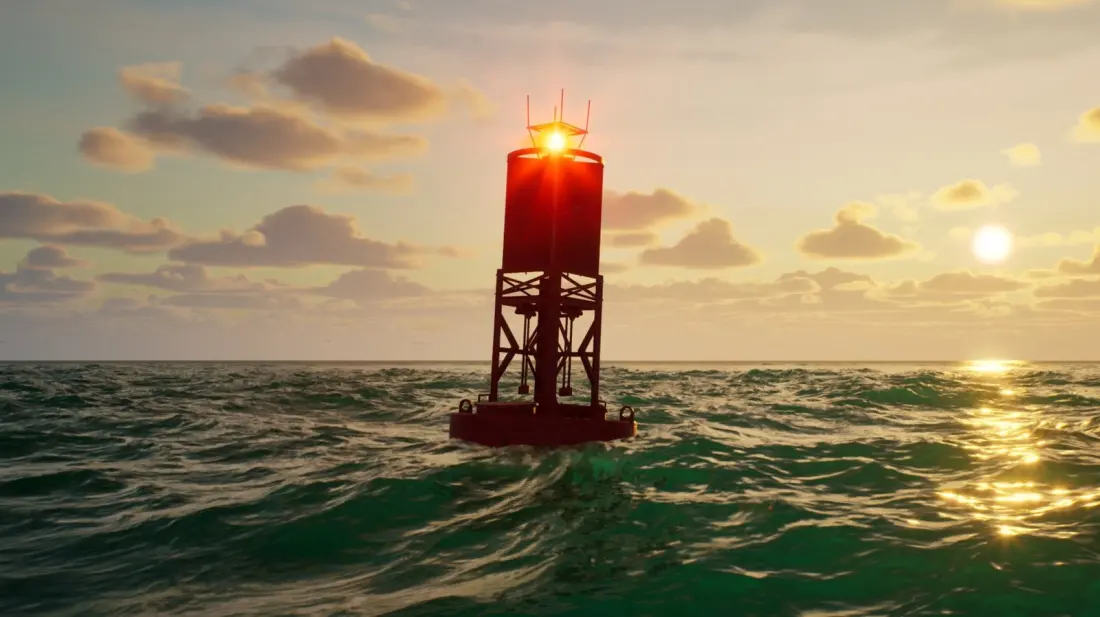
That red-and-black striped buoy bobbing in the middle of a calm lake isn't decoration — it's telling you something important. Known as an isolated danger buoy, it marks a specific hazard lurking beneath otherwise safe, navigable water: a submerged rock, a wreck, or a sudden shallow patch that could wreck your hull and your afternoon.
The design is consistent and easy to learn once you've seen it. The buoy is red in the middle with black on the top and bottom, topped with two black spheres, and sometimes fitted with a white light for visibility after dark. It's moored directly above the danger itself, which is what sets it apart from other warning markers like white buoys with orange diamonds — those flag broader caution zones, while the isolated danger buoy points to one discrete spot. The water all around it is usually perfectly fine to cross.
The practical advice is simple: give it a wide berth. Boating safety bodies such as the National Safety Council stress that understanding navigation markers is a core part of staying safe on the water, alongside wearing a properly fitted life jacket. If you want to know exactly what you're steering around, check the lake's nautical chart — the specific hazard under an isolated danger buoy is typically noted there.
Why should a holidaymaker care? Because renting a boat, jet ski or kayak is one of the most popular activities at lake destinations worldwide, and many casual visitors have never been taught buoy language. Five minutes of learning the basics — red-and-black striped for an isolated hazard, plus the other shape and colour codes — can be the difference between a smooth day out and a costly collision with something you couldn't see. BoatUS Foundation defines buoys simply as anchored floating objects whose shapes and colours indicate their purpose and how to navigate around them; treat them as the water's equivalent of road signs rather than quaint decoration.
This kind of knowledge also opens the door to bigger adventures. Once you're confident reading markers and handling a boat safely, ambitious routes like America's Great Loop — a long-distance Eastern U.S. boating circuit — become realistic goals rather than pipe dreams. Whether you're renting a pontoon for a day or planning a multi-week voyage, buoy literacy is one of those small bits of prep that pays off every single time you leave the dock.