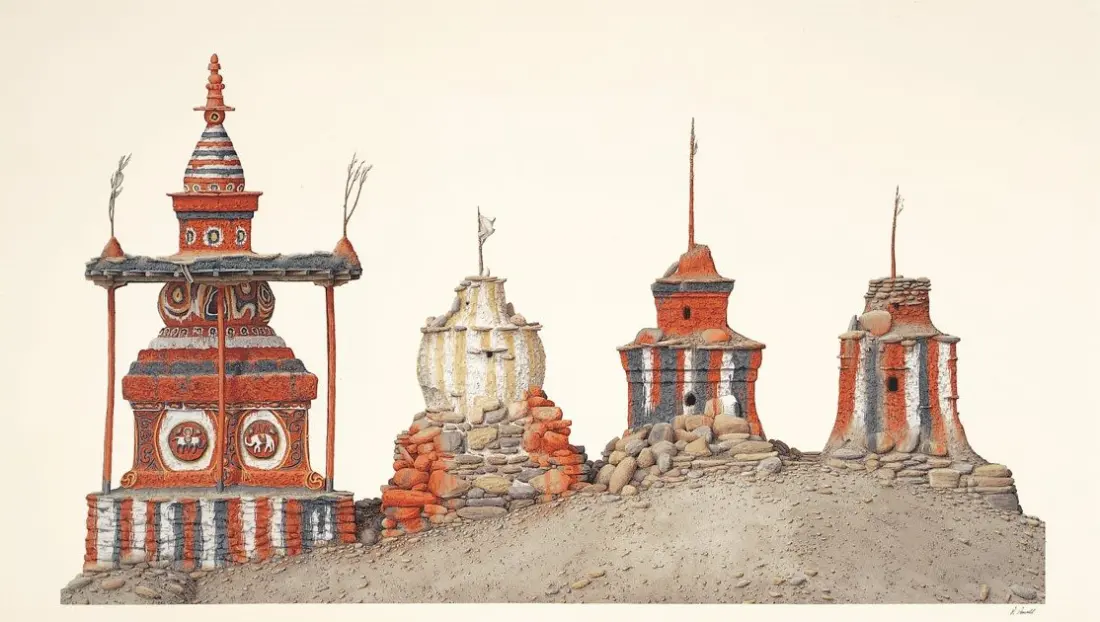
Some painters sketch a building. Robert Powell apparently counted the bricks on the facade of the Kutu Math in Bhaktapur, and the stones in the foundations of the chortens at Lo Manthang, before he painted them. That obsessive care is why his watercolours of Nepal's temples, courtyards and mountain villages are prized by collectors worldwide — and why a long-delayed retrospective is now set for Kathmandu in 2027.
The Australian artist, an architect by training, spent more than three decades in Nepal and travelled across Asia, from Pakistan's Swat Valley to Angkor Wat. His work has near-photographic accuracy, yet remarkably little of it was painted on site. Powell worked in the studio from pencil sketches, photographs and field notes, rebuilding each scene with meticulous draughtsmanship. Curator Sophia L Pandé of Kathmandu's The Kalā Salon, who is organising the retrospective, argues his paintings are a kind of architecture-plus-anthropology: he rarely painted people, choosing instead to read them through the structures they built.
The show was originally planned for the Kathmandu Triennale in 2020, but was shelved after Covid and Powell's own death that year. It now promises to be his most significant exhibition since 'Earth Door, Sky Door: Paintings of Mustang' at the Smithsonian's Sackler Gallery in Washington DC in 1999.
Ahead of it, Pandé has published 'Robert Powell Catalogue, 2026: Verisimilitude & Imagination — A Lifetime of Paintings and Drawings'. Calling it a catalogue undersells it. It gathers tributes from friends and collaborators including Niels Gutschow, Niranjan Kunwar, Sangeeta Thapa, Lisa Choegyal and Powell's wife Lieve Aerts, plus a long essay by artist-architect Ross Feller, who spent a week in Powell's Koh Samui studio just before he died and later studied sketchbooks spanning 40 years. The book reveals another side to Powell: alongside the realist work — goats, a Bhaktapur brick kiln, bicycles piled with red radish, the blood-red cliffs of Drakmar, wall details at Pashupati — he produced surreal, dreamlike compositions of imaginary buildings and terrain, floating in space. Pandé also defends him against any charge of orientalism: he documented what he saw, without ornament or embellishment.
For travellers, the retrospective doubles as a fresh lens on Nepal itself. Wander Bhaktapur's courtyards or the walled city of Lo Manthang in Upper Mustang and you'll spot the very buildings Powell rendered — some, like the 280-year-old Kutu Math, restored by his friend the Austrian architect Götz Hagmüller, who commissioned paintings of its interiors. His work makes a strong case for looking longer at the brick, timber and weathered plaster most visitors walk past. If you're in Kathmandu in 2027, it should be one of the cultural highlights of the year.