A forest area the size of roughly 3,740 football pitches has vanished from three Croatian nature parks over the past decade, according to new satellite analysis that's sparking a very public row with the country's state foresters.
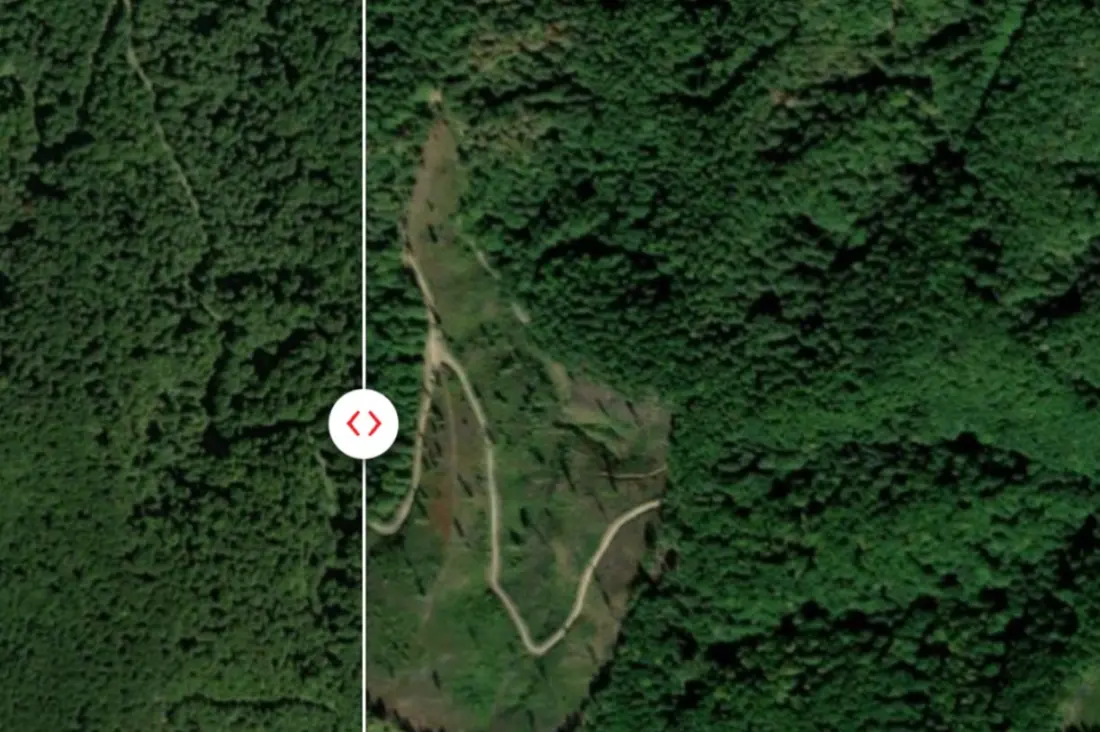
The work comes from Lada Kovjanić, a Zagreb-based programmer who made headlines in October with an interactive map showing forest loss on Medvednica, the mountain above the capital. She has now launched a portal, šume.eco, that tracks changes in tree cover across Croatia's larger forest areas, with special attention on protected parks. Her method is straightforward: compare springtime satellite images from the European Sentinel-2 satellites year by year, when vegetation is densest, and flag where tall tree crowns have gone.
The numbers are striking. In Lonjsko polje Nature Park, analysis of imagery from 2016 to 2026 shows complete or partial loss of tree crowns across 1,246 hectares — about 1,745 football pitches. That matters because Lonjsko polje holds some of Croatia's most valuable floodplain forest, with pedunculate oak, ash and alder. Papuk Nature Park recorded 914 hectares of crown reduction between 2017 and 2026, and Kopački rit lost 509 hectares of high canopy in the same period.
Kovjanić is careful about what the data does and doesn't show. Her maps don't judge legality — storms, disease and drought all play a part — but she says clear-cutting is clearly visible in all three parks. Croatia's state forestry company, Hrvatske šume, pushed back, saying the analysis has "serious shortcomings": some marked areas were never forest, and young woodland is poorly picked up by satellites, so open patches don't automatically equal permanent loss. Kovjanić has invited them to cooperate, arguing transparency could improve management of both state and private forests.
The bigger picture is arguably more worrying. Croatia has lost nearly 86,000 hectares of old forest — trees over 20 metres tall — since 2001, close to six percent of the total. Official inventory data released in June actually shows forest land increasing, but young scrub on abandoned farmland isn't the same as centuries-old woodland. Old trees carry the hollows, dead wood and cracked bark that woodpeckers, owls, bats and rare insects like the stag beetle depend on, and they store the most carbon. If current felling rates continue, a third of the mature forest that existed in 2000 could be gone by 2100. On around 40 percent of areas deforested in the early 2000s, crowns still hadn't reached ten metres by 2020 — a measure of how slow recovery is.
For travellers, this is worth knowing before a trip. Lonjsko polje, Papuk and Kopački rit are beloved for birdwatching, floodplain scenery and walking, and the maps don't mean these parks are ruined — but the quiet, mature woodland sections visitors come for are precisely what's shrinking. The portal also gives independent hikers and nature-lovers a tool to see for themselves what's changed, and where.
Story first reported by Total Croatia.