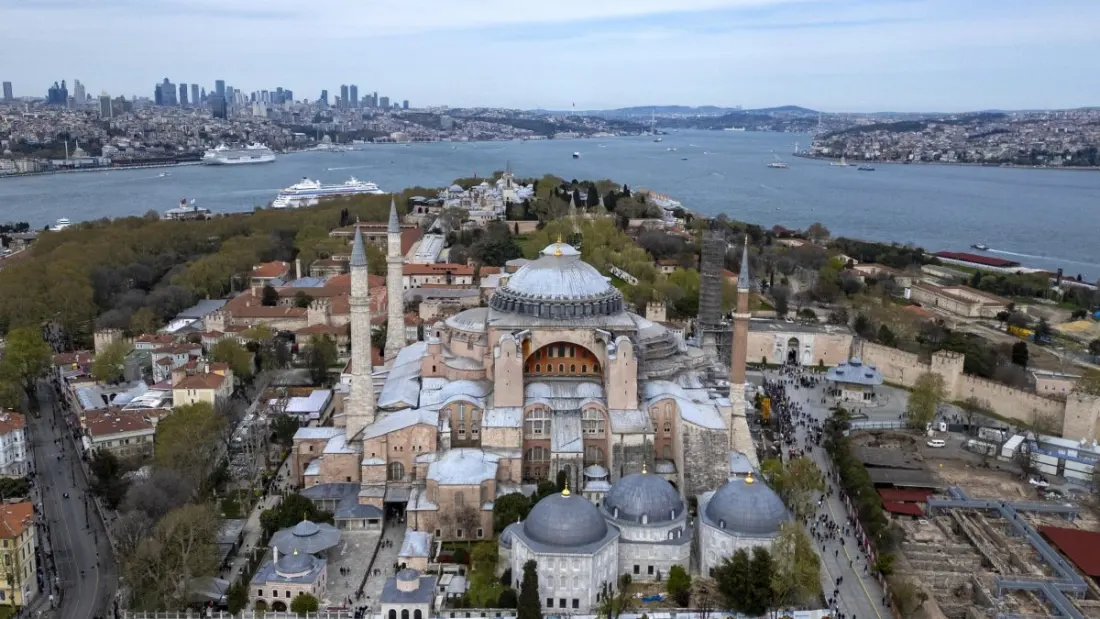
"All roads lead to Rome" turns out to be more medieval proverb than Roman fact. A new international study, published in Nature Communications, used network science to map the empire's overland routes and found that several cities beat Rome itself when it came to connectivity — and two of them are Turkey's biggest travel destinations today.
Researchers from Aarhus University, Queen Mary University of London and the Universitat Autonoma de Barcelona measured each city's importance through three lenses: how many roads linked to it, how easily travellers could reach it, and how often it acted as the bridge between separate routes. Ancient Byzantium — modern Istanbul — topped Rome on those measures, thanks to its position straddling Europe and Asia. Ankara, then the Roman provincial capital Ancyra of Galatia, also ranked above the imperial capital, its central Anatolian location making it the natural hub for east-west traffic across the peninsula.
The study's scope is striking. The team built a high-resolution digital dataset covering roughly 299,000 kilometres of Roman roads, now publicly available on the Itiner-e platform. They traced routes from frontier roads along the Rhine, Danube and Euphrates — many built for military purposes — to mountain paths in Turkey's Taurus Mountains climbing to around 2,000 metres, built to connect frontier garrisons rather than settlements.
Perhaps the most interesting takeaway for anyone who travels: the past hasn't gone anywhere. Many modern roads across Europe, the Middle East and North Africa still follow alignments laid down nearly 2,000 years ago, especially where ancient cities grew into today's population centres. The routes moved goods, soldiers, ideas, religions — and even diseases — and their fingerprints remain on how we get around now.
For travellers, this reframes a visit to Turkey. Istanbul's straddling position isn't just scenic; it made it the empire's genuine overland junction, which helps explain why the city accumulated layer upon layer of history worth exploring. Ankara, often skipped in favour of coastal spots, was a capital long before it became Turkey's modern capital — its archaeological museum holds some of the best Hittite and Roman material in the country. Even Antakya, ancient Antiochia, made the above-Rome list.
There's also a treasure-hunting angle. According to Istanbul University's Hamdi Şahin, who contributed data from mountainous Cilicia in the country's south, between 400 and 500 new inscriptions — including Roman milestones — are still discovered in Turkey every year. Surviving stretches of paved Roman road are out there, often in remote upland areas where hikers can walk routes the legions once used.
So next time you're stuck in traffic in Istanbul or driving across the Anatolian plateau, remember: you're likely following the same logic of connectivity the Romans engineered two millennia ago. The empire's capital had the prestige, but Turkey's cities had the geography.