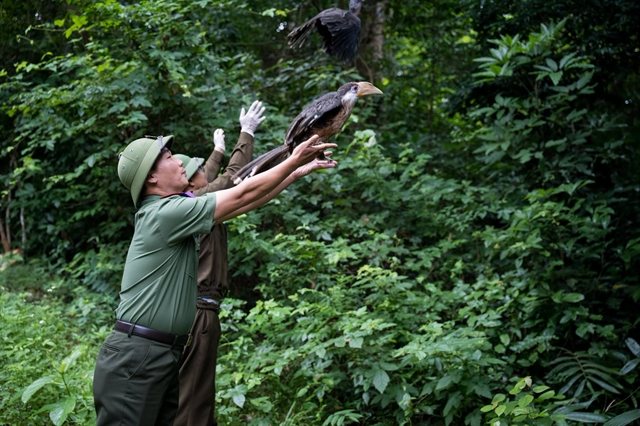
A Sunda pangolin, a Hà Tĩnh langur, three pygmy slow lorises and a crested serpent eagle were among seventeen wild animals released back into the forests of central Vietnam on October 8. The Phong Nha – Kẻ Bàng National Park Management Board, working with local authorities in Quảng Trị Province, carried out the release after months of rehabilitation at the park's Centre for Rescue, Conservation and Development of Organisms.
The full cast list reads like a rare-species roll call: seven Indochinese pig-tailed macaques, one crested serpent eagle, three pygmy slow lorises, two brown hornbills, two crested goshawks, one Hà Tĩnh langur and one Sunda pangolin. Most of these animals had been rescued from the illegal wildlife trade or from situations where they could no longer survive on their own, and each was given a full health check plus an assessment of whether it could cope in the wild before being cleared for release.
Every species in the group falls under Vietnam's strictest protection categories — Groups IB and IIB under the Ministry of Agriculture and Environment — and several are covered by CITES, the international treaty governing trade in endangered wildlife. Group IB species are prioritised for protection, with any commercial exploitation of wild-caught specimens banned outright; Group IIB species have commercial use tightly restricted. The Sunda pangolin, one of the world's most trafficked mammals, is a particularly significant returnee.
Release sites weren't chosen at random. Rangers matched each species to terrain that offered the right habitat, enough natural food, shelter and — crucially — safety from human threats. That kind of species-by-species planning is what separates a genuine rewilding effort from a photo op.
For travellers, this is a good reason to look past Vietnam's beaches and caves. The Phong Nha – Kẻ Bàng region is already famous for Son Doong, the world's largest cave, and its karst forests shelter some of Southeast Asia's most elusive wildlife. Conservation-focused tourism in the area — guided treks, ethical wildlife-watching and visits that support rescue centres — directly funds the kind of work that put these seventeen animals back where they belong. If you're visiting the park, choosing operators who work with the rescue and conservation centre is the simplest way to make your trip count.
Story reported by Vietnam News Life.