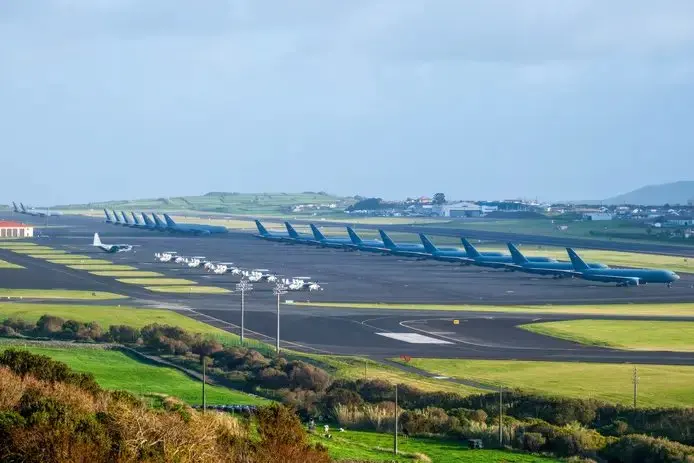
Lajes Air Base on Terceira Island in the Azores has quietly become one of the most-watched patches of tarmac in the Atlantic. Portuguese state news agency Lusa reports that 17 American KC-46 Pegasus refuelling aircraft are currently parked there, a number that jumped sharply on 11 October after months of thinner activity.
The pattern matters. Back in February, days before the US and Israeli strikes on Iran, 15 of these tankers arrived at Lajes and activity was intense for months, with daily take-offs and landings. By September only six remained. Then came the October reinforcement, mirroring the pre-strike build-up. On Wednesday, eight of the tankers left the island, though reportedly only on training missions, and this morning none of the 17 on site had moved, with US personnel seen aboard just one aircraft, likely carrying out maintenance.
The backdrop is rising tension in the Strait of Hormuz, three US aircraft carriers now in the Middle East (the USS Theodore Roosevelt joining the USS George H. W. Bush and USS George Washington), and Washington speculation about possible further strikes on Iran after the US and Israeli elections. Even the US Ambassador to the UN, Michael Waltz, told the Financial Times the conflict with Iran could still be deadlocked a year from now, while voicing hope Tehran would negotiate sooner.
Closer to home, the base itself is now the subject of political friction. Portugal's Public Prosecutor's Office opened an inquiry this month into the legality of America's use of Lajes in the Iran conflict, following a complaint from the Left Bloc. Prime Minister Luís Montenegro has insisted his conviction that the US is complying with all legal requirements is "absolutely unshakeable".
Why should travellers care? Terceira's Lajes airport is jointly military and civilian — it's the transatlantic diversion airport countless commercial flights rely on, and a gateway for visitors to the Azores. Its role as a strategic US staging point has shaped the islands for decades, and spikes in activity like this one are closely watched as a barometer of what may come next in the Middle East. For anyone planning a trip to Terceira, day-to-day tourism is unaffected; civilian flights continue as normal. But the sight of tankers stacked on the runway is a reminder of how central this mid-Atlantic archipelago remains to global geopolitics — and of the unusual mix of crater lakes, whale-watching and NATO hardware that defines a holiday there.