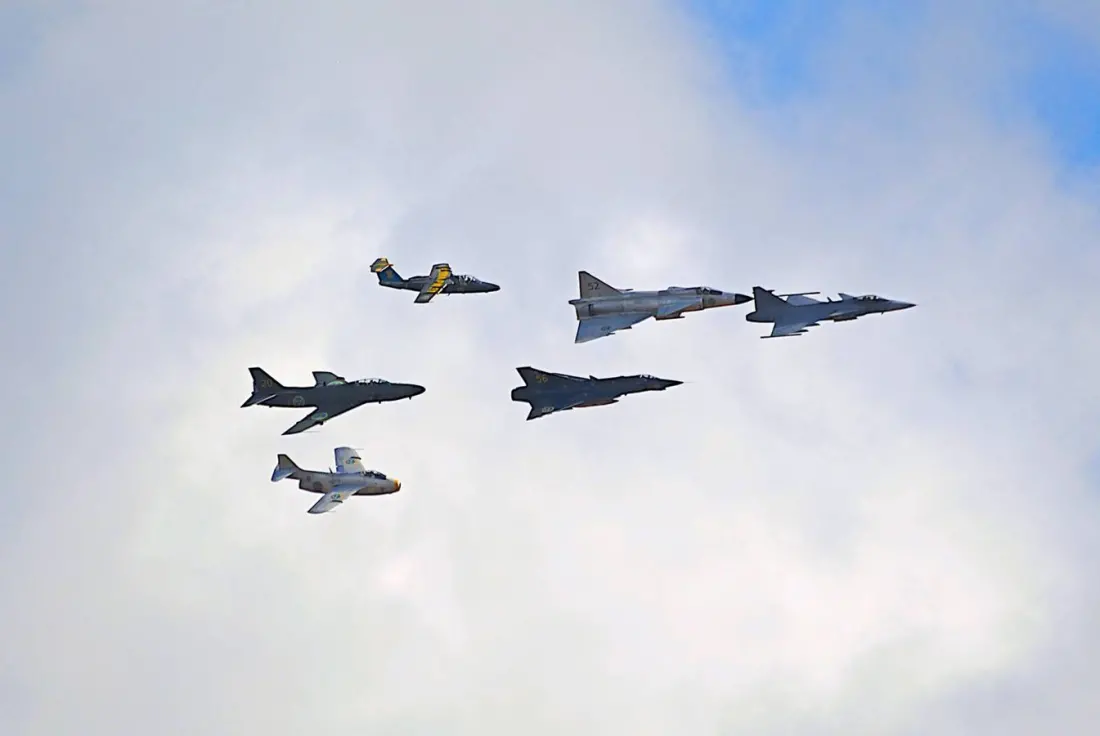
The Swedish Air Force marked its centenary with a big celebration at Malmen Air Base, and the star of the show was Saab itself. Nearly every fighter jet the company has ever built was on the flight line, from a 1940s pusher-prop oddity to a tailless stealth mock-up, with much of it flying in formation thanks to the volunteer pilots and engineers of the Swedish Air Force Historic Flight.
Saab's designs have always been shaped by Sweden's armed neutrality. Aircraft had to operate from forest roads and frozen fields, be maintained by conscripts, and avoid foreign components. That produced some genuinely unusual engineering. The Saab 21R began life as a piston fighter with a pusher propeller and an early ejection seat, then became one of only two production fighters ever converted to jet power. The 29 Tunnan, with its comically round "Flying Barrel" fuselage, carried the first swept wing to enter operational service in Europe and set a world speed record in 1954 — it is also the only Saab fighter to see combat, flying UN missions during the Congo Crisis. One of the airshow's best moments had a Tunnan flying alongside a MiG-15 and an F-86 Sabre, Cold War rivals sharing one sky.
Later types got more ambitious. The 32 Lansen brought radar and all-weather capability to Swedish squadrons and served in recon roles into the late 1990s. The Saab 105, known at home as the Sk 60, has trained pilots since 1963 and still leads the Team 60 aerobatic display team. The 35 Draken, with its striking double-delta wing, made Sweden the first small nation to field a Mach 2 fighter — and Draken pilots invented the now-famous "Cobra" maneuver years before the Su-27 made it famous. The 37 Viggen could land on a 500-metre strip, turn around using a thrust reverser, and fold its tailfin to fit inside mountain bunkers; it was also the first aircraft outside the US with an onboard digital computer. At Malmen it performed its signature reverse-thrust turnaround, a trick few modern fighters can match.
For anyone drawn to aviation heritage, Sweden is a rewarding place to see it live. The Swedish Air Force Historic Flight keeps these jets airworthy with volunteer crews, and events at bases like Malmen — near Linköping, Saab's home city — offer a rare chance to watch Cold War hardware fly rather than sit in a hangar. Even newer tech made an appearance: Saab unveiled the A3-001, a stealthy tailless concept for future autonomous combat aircraft, the day before the flying displays began.