
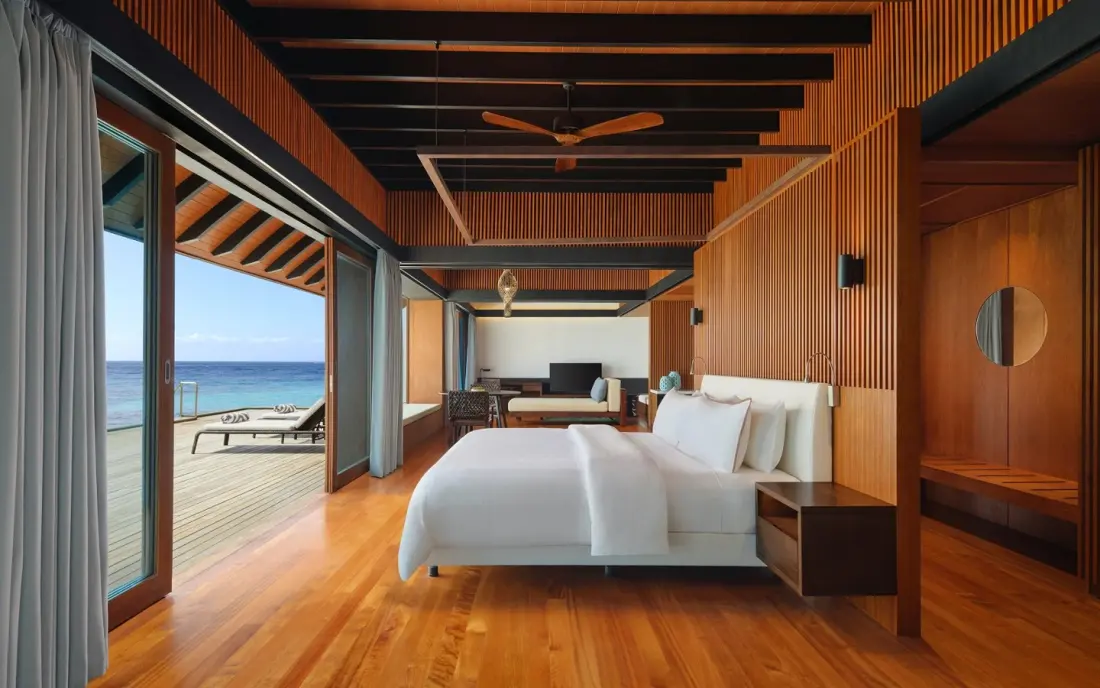
Could the point of your next holiday be, quite simply, sleeping better? At The Westin Maldives Miriandhoo Resort in the Baa Atoll — a UNESCO Biosphere Reserve — that's exactly the pitch, and it taps into one of travel's fastest-growing trends. Sleep tourism took off with Gen Z travellers and has spread across age groups, and the numbers back it up: the Global Wellness Institute found that more than 90% of travellers would pay up to 10% extra for hotels that genuinely promise better sleep.
The resort, part of Marriott's Bonvoy portfolio, has 69 eco-friendly pool villas designed by Italian firm PEIA Associati, each with a private deck and ocean views. General Manager Vijay Kumar explains that the property's Sleep Well philosophy starts with the architecture itself. A resort-wide double-roof system keeps air moving naturally through the villas, so guests aren't sleeping in sealed, over-conditioned boxes. Warm, low lighting and brown-toned wood finishes shift the mood in the evenings, and the layout of overwater and beach villas keeps the lagoon's soundscape — waves, breeze, birds — close enough to do its work.
Then there's the Heavenly Bed, the centrepiece of the whole programme. It comes backed by Westin's signature sleep extras: a bedside lavender balm infused with lavender and chamomile oils that staff suggest rubbing on temples or wrists before lights out, and a dedicated Sleep Well Menu of superfoods available through in-room dining. The idea is that rest is engineered from every angle — food, scent, bedding, light and sound — rather than left to chance.
Beyond the bedroom, the resort keeps the wellness thread running. The overwater Heavenly Spa by Westin sits in a glazed volume under a protective roof shell that keeps it visually connected to the ocean. There are four restaurants covering different cuisines, a WestinWorkout Fitness Studio and a multi-function recreation ground, so guests can pair their sleep-focused stay with the usual Maldives mix of eating, moving and floating.
Why does this matter to travellers? Because sleep tourism is moving from gimmick to genuine product category, and this review is a useful case study in what that actually looks like in practice. If you struggle with sleep at home and fancy a trip where rest is the headline activity rather than a side effect, a resort built around it — with design, amenities and menus all pulling in the same direction — is worth a look. It also helps that the setting is hard to beat: marine-rich Baa Atoll waters right at the villa deck, with the natural rhythms of the island doing half the therapeutic work on their own.
Reviewed by contributor Katha Nauriyal for Hotel Designs.