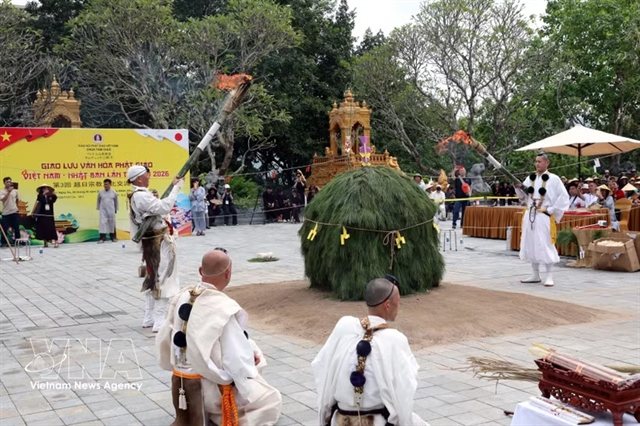
A crowd of nearly 1,000 — Buddhist monks, nuns, followers and visitors from Japan — gathered at Tam Chúc national tourism site in Vietnam's Ninh Bình province on October 24-25 for the 2026 Việt Nam–Japan Buddhist Cultural Exchange Festival, held under the theme 'Prayers Beyond Borders'.
The biennial festival, co-hosted by the Việt Nam Buddhist Sangha, the provincial Buddhist Sangha and Tam Chúc Pagoda, has now been held in Vietnam three times. But this year's edition had a genuine rarity at its centre: a large outdoor Goma fire ceremony, known as Saito Ogomaku, performed by Shugendo practitioners.
The ritual is uncommon even in Japan. Rooted in Shugendo — the mountain ascetic tradition that blends Indian Buddhism, esoteric Buddhism and Chinese Taoism — it is traditionally staged outdoors and seldom performed abroad. During the ceremony, prayers for good health, the lifting of misfortune and the granting of wishes are symbolically given to the flames, which represent the sun's life-giving power. The bravest participants can then join a fire-walking ritual once the main rite ends.
Venerable Sekiguchi of Keifukuji Temple, who led the Japanese delegation from the Saitama Buddhist society, described the fire ceremony as one of the festival's main draws. A flower-offering ceremony formed the other centrepiece, drawing on the Buddhist tradition of scattering flowers to welcome the Buddha, purify the space and drive away evil spirits.
For organisers, the event works both ways. Nguyễn Xuân Trung, director of Tam Chúc Tourism and Services Company, said the festival lets Vietnamese residents and international visitors experience Japanese traditional culture through performances and activities, while introducing Japanese customs and destinations to locals — and promoting Tam Chúc and Ninh Bình's spiritual sites to Japanese people living in Vietnam.
For travellers, it's a reminder of what Ninh Bình offers beyond its famous karst scenery. Tam Chúc Pagoda is one of the largest Buddhist complexes in Vietnam, set against limestone mountains and a lake, and events like this show the province positioning itself as a spiritual tourism hub with genuine international programming. If the festival returns in its next biennial cycle, timing a trip around it would let you see a centuries-old Japanese rite you'd otherwise likely have to travel to remote Japanese mountains to witness.