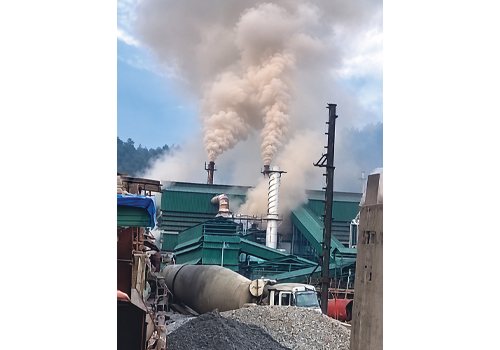
Southern Bhutan has built its reputation on clean air and forested hills, so images of thick smoke rising from factory stacks near Samtse caused an understandable stir. The fuss began when a local resident, Shyam Lal, posted photos on social media showing heavy plumes from a stack at the Norbugang Industrial Park, warning that the once-green area was changing and that haze occasionally drifted towards neighbouring communities and even Samtse town itself.
Officials have pushed back on the idea of constant pollution. Samtse Dzongda Melam Zangpo and other local figures say the dramatic smoke events are usually tied to machine breakdowns, repairs and power fluctuations rather than routine dumping. Most of the factories in the park have been running for less than a year, which they attribute to teething problems during startup phases. One anonymous official put it plainly: the thick emissions are occasional, not a daily reality.
Residents closer to the fence line are less reassured. A man from nearby Chengmari named Deepen described a faint foul smell and visible haze drifting through the valley at times. Some observers also raise the possibility of transboundary emissions from across the nearby Indian border, though nothing has been formally mapped or verified.
The stakes are real because of what Norbugang actually produces. The park is zoned mainly for heavy metallurgy and ferro-alloy smelting, processes that emit fine micro-silica dust capable of penetrating deep into the lungs, along with carbon monoxide, sulphur dioxide and nitrogen oxides. Bhutan's National Environment Commission does have limits: 150 mg/Nm3 for particulate matter, 100 mg/Nm3 each for SO2 and NOx, 50 mg/Nm3 for CO, and 25 mg/Nm3 for fluoride under the 2020 Environmental Standards. But the deeper question locals are asking is whether per-factory compliance means anything when several ferro-silicon plants run simultaneously in one tight valley. The Department of Environment and Climate Change did not respond to requests for comment on monitoring protocols.
Why should a traveller care? Bhutan's appeal rests heavily on its environmental image, and the country's low-volume, high-value tourism model depends on it. Samtse itself is off most visitor itineraries, but the episode is a useful snapshot of the tension between Bhutan's industrial ambitions in the south and the pristine reputation that draws people to the kingdom in the first place. Anyone heading to western or southern districts may notice industrial activity along the border belt that sits oddly beside the postcard image. Watch this space — the source paper has promised follow-ups as regulators respond.