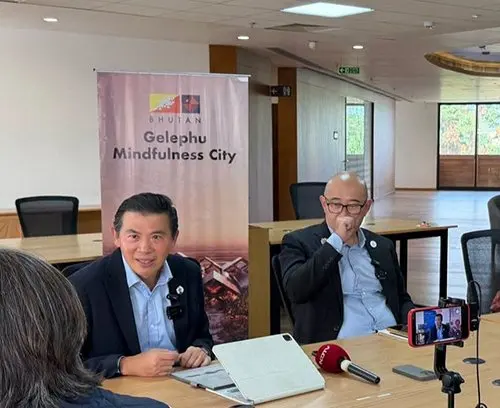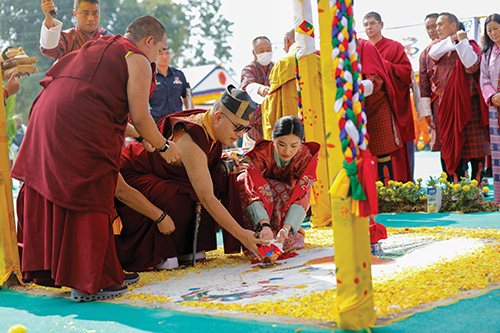
Gelephu, the southern town being transformed into Bhutan's ambitious Mindfulness City, has added another landmark to its pipeline. The 17th Gyalwang Karmapa, Ogyen Trinley Dorje, recently presided over the groundbreaking of Jampal Gyepai Dangden, a new stupa dedicated to Manjushri, the Bodhisattva of Wisdom. The name translates roughly as 'The Radiant, Joyful Smile of Manjushri' — a reference to the serene smile of wisdom said to bring peace to anyone who sees, visits, or walks around the structure.
The ceremony carried royal weight. Her Majesty The Gyaltsuen, who serves as Royal Patron of the project, attended alongside the Karmapa, one of the most senior figures in Tibetan Buddhism and head of the Karma Kagyu school.
There's a deep historical thread behind the choice of dedication. The project honours a spiritual link between the Karma Kagyu tradition and Mount Wutai in China, considered Manjushri's sacred abode. That connection goes back more than 600 years, to 1408, when the 5th Karmapa, Deshin Shegpa, made a pilgrimage to the mountain. The new stupa essentially plants that old relationship into Bhutanese soil.
The stupa is also one piece of something much larger. It's among 22 spiritual projects in Gelephu Mindfulness City that have received Royal Kasho approval to begin — temples, stupas and Buddhist centres led by respected masters from different Buddhist traditions. Together they underpin the King's vision of the city as a hub for Vajrayana Buddhism, sometimes described as a 'Buddhist City'.
Why should this be on a traveller's radar? Gelephu Mindfulness City is one of the most talked-about projects in Asian tourism right now — a planned economic and spiritual zone on Bhutan's border with India, designed around wellness, contemplation and low-impact development. Anyone interested in watching a new pilgrimage destination take shape from the ground up has a rare window right now. Early visitors to Gelephu get the region before the infrastructure, crowds and itinerary articles arrive. And for Buddhist travellers in particular, the steady arrival of major religious figures and sacred projects signals that this is becoming a genuine place of practice, not just a branded concept.