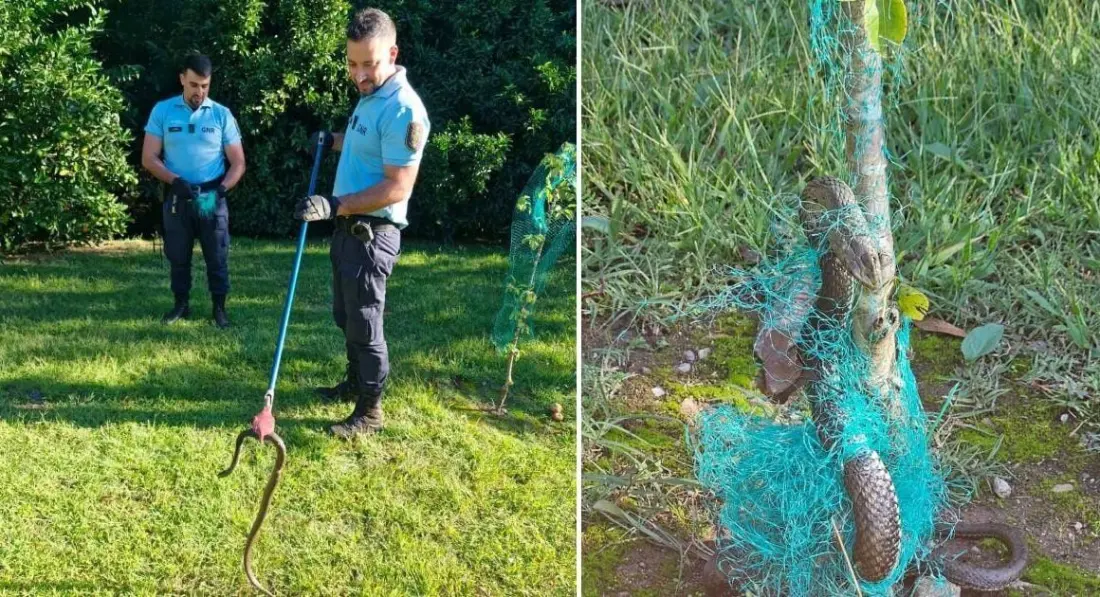
A snake in Portugal's north got itself in a tangle recently — literally. Officers from the GNR, the country's National Republican Guard, were called out in Ponte de Lima, a riverside town in the Viana do Castelo district, after the reptile became trapped in protective netting. Working carefully, the officers cut it free and released it back into the wild, photos and all.
The Viana do Castelo Territorial Command confirmed the rescue in a statement issued on Saturday, October 17, crediting the local GNR Territorial Post with the operation. The force used the moment to make a broader point, telling followers that "protecting wild fauna means contributing to the balance of nature." It didn't say which species of snake was involved or pinpoint exactly where the rescue took place — northern Portugal is home to several harmless species, including the viviparous snake and the ladder snake, neither of which is dangerous to humans.
Odd as it sounds, this kind of call-out is fairly routine for the GNR, a gendarmerie-style force whose duties range far beyond policing. Rural units regularly handle everything from forest fires to lost livestock to wildlife in trouble, and the force often posts these rescues on social media as a nudge to the public about coexisting with local animals.
For travellers, the story is a small window into the Portugal beyond the beaches. Ponte de Lima sits in the Minho, the lush green corner of the country near the Spanish border, and it's often billed as Portugal's oldest town — a compact place of a medieval bridge over the Lima river, Roman milestones, and a well-known international garden festival held in spring and summer. The surrounding countryside is a patchwork of vineyards (this is vinho verde country), cornfields and forest paths along the Central Portuguese Camino, the pilgrimage route that passes right through town on its way to Santiago de Compostela.
Which brings us back to that netting. In agricultural regions like the Minho, protective netting over crops and fruit trees is everywhere — great for growers, occasionally a hazard for snakes, birds and other wildlife that get snarled in it. If you're walking the Camino stages or hiking around Ponte de Lima and spot a trapped animal, local police or the GNR (emergency number 112) are the people to call. And if you meet a snake on a trail, the sensible move is the one Portuguese farmers have long practised: give it space and let it go on its way. Almost all of the species you'll encounter here are protected and entirely harmless.
It's a modest story, but a charming one — and a good excuse to put a rarely-visited corner of northern Portugal on your radar.