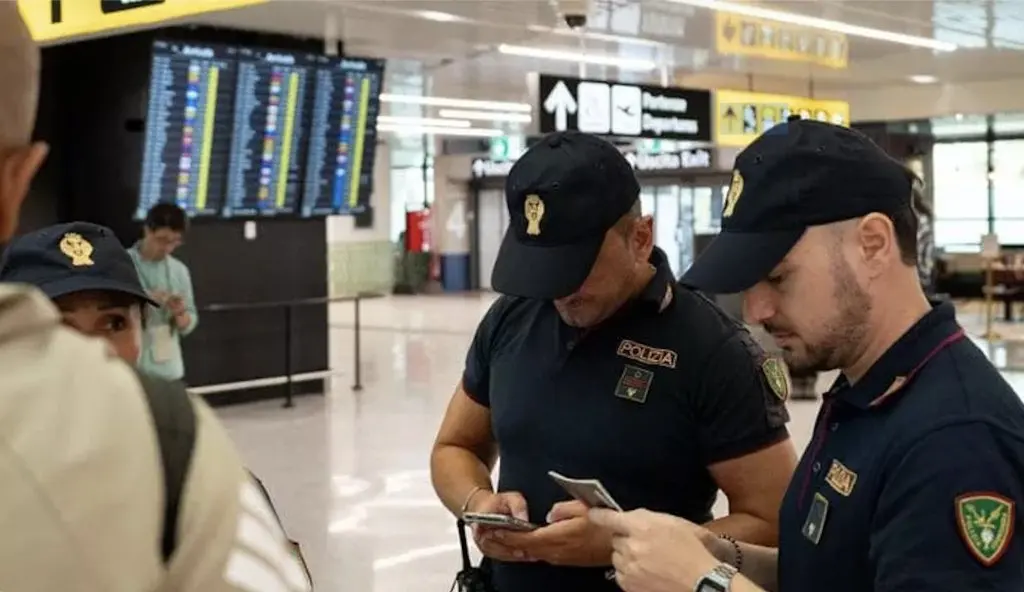
If you're flying or sailing directly between Spain and Italy this autumn, expect an ID check on arrival — and possibly a short queue. Both governments have once again extended reciprocal border controls, with Spain's measures now running until at least 8 October 2026, and Italy confirming its own checks will continue in parallel.
The dispute traces back to late July 2026, when more than 72,000 migrants crossed into Ceuta, the Spanish enclave on Morocco's north African coast, in a matter of days. Italian Prime Minister Giorgia Meloni responded on 31 July by announcing an 'extraordinary measure': temporary controls on air and sea arrivals from Spain, initially aimed at non-EU nationals, in force from 1 August. Madrid retaliated a week later with its own checks on passengers arriving from Italy, and the two measures have been rolled forward repeatedly ever since.
Because the two countries share no land border, the controls only bite at airports and ports handling direct Spain–Italy connections — think Madrid, Barcelona, Rome and Milan, plus ferry routes. But that's precisely where most leisure travellers pass, so anyone on a direct flight or ferry between the two should carry a passport or national ID and allow a little extra time on arrival.
The political temperature is high. Spanish Foreign Minister José Manuel Albares branded Rome's latest extension 'absurd, useless and a disgrace', arguing there is no threat to Schengen from Ceuta and Melilla, and pointing out that Italy is currently recording twice as many irregular arrivals as Spain. He also noted Madrid had helped Italy during the 2023 Lampedusa crisis by taking in transferred migrants. Rome, unmoved, insists the checks are purely about security, with Interior Minister Matteo Piantedosi citing 'high risks to internal security' and a 'possible threat of terrorist infiltration'. Foreign Minister Antonio Tajani called Spain's reaction 'unnecessarily aggressive' and said Italy is simply applying European rules.
Both countries are members of the Schengen area, which normally abolishes internal border checks across its 29 member states — but the rules allow temporary reintroduction of controls, and both governments have duly notified the European Commission. There's no stated end date beyond the current 15-day cycles, so further extensions are possible if the Ceuta situation doesn't calm down.
For holidaymakers, the practical impact so far looks minor — this is document checking at ports and airports, not closed borders or visa requirements. EU citizens and most visitors can still move freely with standard ID. But if you have a tight connection, a same-day ferry transfer or a timed tour booked on arrival, build in buffer time and keep your travel documents easily accessible. Watch for updates if you're travelling later in October, since either side could extend again or lift the measures early if circumstances change.
It's also a reminder that Schengen isn't an all-or-nothing system: several member states have maintained or reinstated internal checks in recent years, and Spain–Italy is now one of the more visible examples. Check your route before you fly, and if you're combining the two countries on one trip, factor the controls into your planning.