Arizona has quietly become a two-part pilgrimage for anyone fascinated by what's above us: dark-sky stargazing inside a city, and a colossal crater punched into the desert 50,000 years ago.
Start in Scottsdale, next door to Phoenix and about half an hour from Sky Harbor International Airport. The city has designated dark sky zones within its own limits — an unusual move for an urban area — and local operators are leaning into astrotourism, meaning travel built around stargazing, astrophotography and night-sky experiences. The ADERO Hotel Scottsdale hosts regular telescope sessions with a group called The Star Dudes, who set up on the hotel lawn and talk visitors through the cosmos. Our correspondent arrived at the tail end of monsoon season, when sheet lightning kept interrupting the stars, but the setup works even when conditions are imperfect — and guides like Vickey Derkson frame stargazing as more than science, linking it to ancient storytelling and the curiosity that light pollution is eroding, one city at a time.
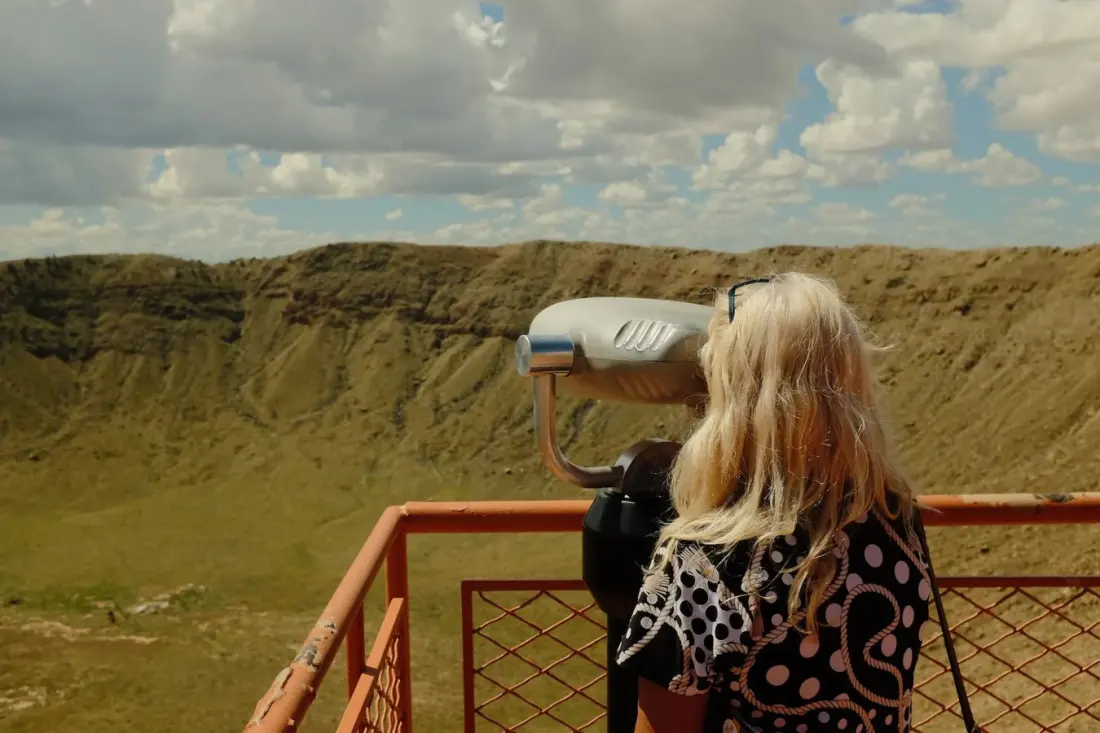
The next morning's drive heads north to somewhere the sky literally landed. Meteor Crater Natural Landmark — officially Barringer Crater — formed when an asteroid weighing around 170 million tons slammed into the high plains at 46,000 km/h, releasing energy equivalent to a 10-megaton nuclear bomb and vapourizing on impact, presumably along with some unfortunate mammoths. The result: a hole roughly one kilometre across and 170 metres deep, its rim rising about 45 metres above the surrounding plain.
Geologist Daniel Barringer was the first to argue in the late 19th century that it was an impact site rather than a volcanic feature — a theory later proven, and a lucrative one, as his family mined the iron ore left by the meteorite. The Barringers still privately own the site today. Navajo Nation and Hopi communities, of course, had known the formation for millennia before that. NASA trained astronauts at the crater in the 1960s, and an actual moon lander now sits by the entrance next to a spaceman statue.
Practically speaking, admission runs $25 to $29, there's a visitor centre with solid interpretive displays and NASA history, guided rim tours, and plenty of viewpoints — though you can't descend to the bottom. Budget about 90 minutes, more with the guided tour or if the kids take to the interactive space games. The crater sits about 30 minutes west of Winslow, making it an easy stop on a Route 66 itinerary. At 1,719 metres of elevation it runs cooler than Phoenix, but fall through spring remains the smartest window for a visit.
Together, the two stops make a tidy themed trip: an evening of telescopes in Scottsdale, a morning staring into the aftermath of an actual asteroid strike. It suits families with space-mad kids, photographers chasing night skies, and anyone road-tripping Route 66 who wants a stop that's genuinely hard to believe until you're standing on the rim. Just time it outside monsoon season — and keep an eye on the sky anyway.