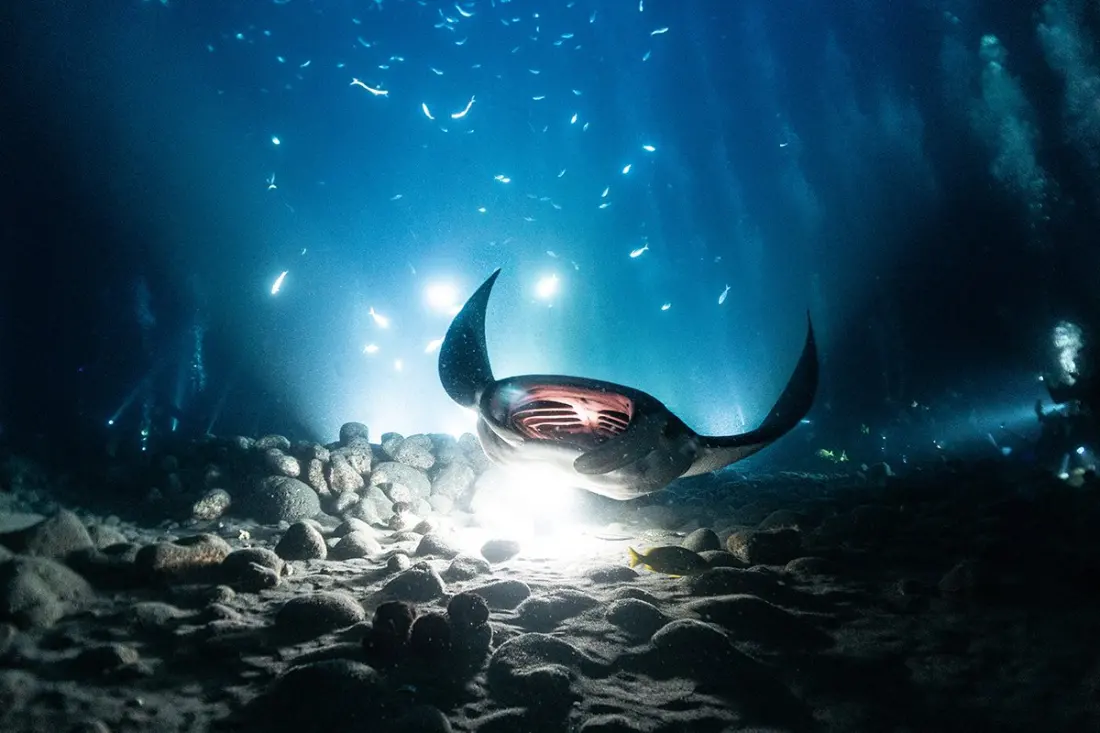
Off the Kona Coast of Hawai'i Island, after dark, boats switch on underwater lights and the show begins. The beams draw clouds of zooplankton to the surface, and manta rays arrive to feed, gliding inches below snorkellers who hang onto illuminated platforms. Wingspans here routinely hit 10 to 12 feet, and the animals have been returning to these feeding sites night after night for years, making Kona one of the most reliable places on Earth to get in the water with them.
Tours typically leave around sunset and motor to established sites along the coast. You stay at the surface, hold your spot on the light platform, and the mantas do the rest, swooping up through the plankton in what feels like slow motion. Unlike stingrays, mantas have no barb and no interest in people — they're filter feeders focused entirely on the tiny organisms in the lights.
In Hawaiian, manta rays are hāhālua, and they carry real cultural weight. They appear in the Kumulipo, the Hawaiian creation chant, and some families regard them as 'aumākua — ancestral guardians believed to offer protection. That sense of grace and calm is easy to understand once you've watched one pass overhead.
The science is just as compelling. Two species live in Hawaiian waters: the giant manta ray, which can reach a 26-foot wingspan, and the reef manta, the 10-to-18-foot animal you'll usually meet on a Kona night tour. Keller Laros, a Kailua-Kona dive instructor since 1991 and founder of the Manta Pacific Research Foundation, notes that mantas have the largest brain-to-body ratio of any fish — a brain roughly the size of a human fist — and may even recognise themselves in mirrors. Each ray's belly spot pattern is unique, letting researchers track individuals across Hawai'i Island, Maui and O'ahu. Some live 40 to 50 years or more. One tracked female, nicknamed Big Bertha, covered about 40 miles in 12 hours.
The work of people like Laros has also shaped the rules. His foundation pushed for legal protection, and in 2009 Hawai'i made it illegal to kill or capture manta rays. Researchers are now mapping family trees through DNA and even studying whether rays have social hierarchies — including possible alpha leaders. One striking finding: reef mantas almost never cross between islands. The 'Alenuihāhā Channel between Hawai'i Island and Maui is estimated to see a single male crossing every 50 to 150 years, and a female only every 500 to 1,500 years, because the channel plunges toward 7,000 feet while reef mantas stick to water about 100 feet deep.
For travellers, that island loyalty is good news: the rays you see off Kona live there year-round, so there's no season to chase. You'll need basic snorkelling confidence rather than dive certification on most tours, and the whole experience happens within a few feet of the surface. If you want a marine encounter that's equal parts adrenaline and cultural depth, this is one of Hawai'i's signature experiences for good reason.