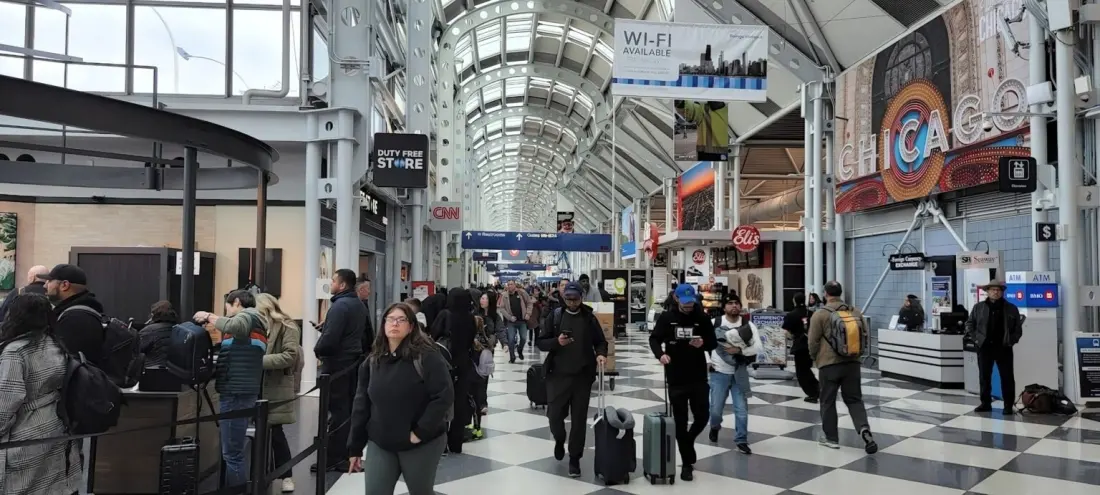
One of America's busiest airports sits inside city limits thanks to a land grab thinner than a tennis court is long. In the 1950s, Chicago wanted O'Hare Airport on its tax rolls, but the suburbs of Norridge and Harwood Heights physically blocked the city from annexing the site directly. Under Illinois rules at the time, you couldn't leapfrog over neighbouring municipalities to claim non-contiguous land.
Mayor Richard J. Daley found a workaround in 1956: Chicago annexed a narrow corridor running along Higgins Road, connecting the city to the airport parcel. At its narrowest points, that corridor was less than 33 feet wide. Legal? Apparently yes. Subtle? Not remotely — the entire point was to draw O'Hare into Chicago so the city could collect the airport's substantial tax revenue, which it has been doing ever since.
The story resurfaced in a roundup from View from the Wing, where the author paired it with a broader question: is O'Hare still worth fighting for? United and American both treat Chicago as a major battleground for premium travellers and credit-card spending, and the airport remains one of the country's most important connecting hubs. But the economic backdrop is shifting. Chicago's metro economy grew only about 5% between 2018 and 2023, well behind the 12–14% posted by comparable big cities. The city faces an $882 million budget gap, with debt and pension payments eating roughly 40% of its operating budget. High business taxes, unpredictable permitting and restrictive zoning are cited as factors pushing investment and residents elsewhere.
Why does this matter to a traveller? Partly it's just a great piece of aviation trivia — the reason your flight says "Chicago" but the airport borders two suburbs you've never heard of. Partly it's practical: O'Hare's status as a duopoly hub is why fares, lounge access and premium cabin competition there are so fierce, and why both United and American keep pouring money into the airport's ongoing multi-billion-dollar expansion. Whether the city's fiscal pressures eventually dull that competition is a fair question for anyone booking connecting itineraries through ORD.
For now, though, the arrangement Daley engineered seven decades ago keeps doing exactly what it was designed to do — and every landing at O'Hare still lands, tax-wise, in Chicago.