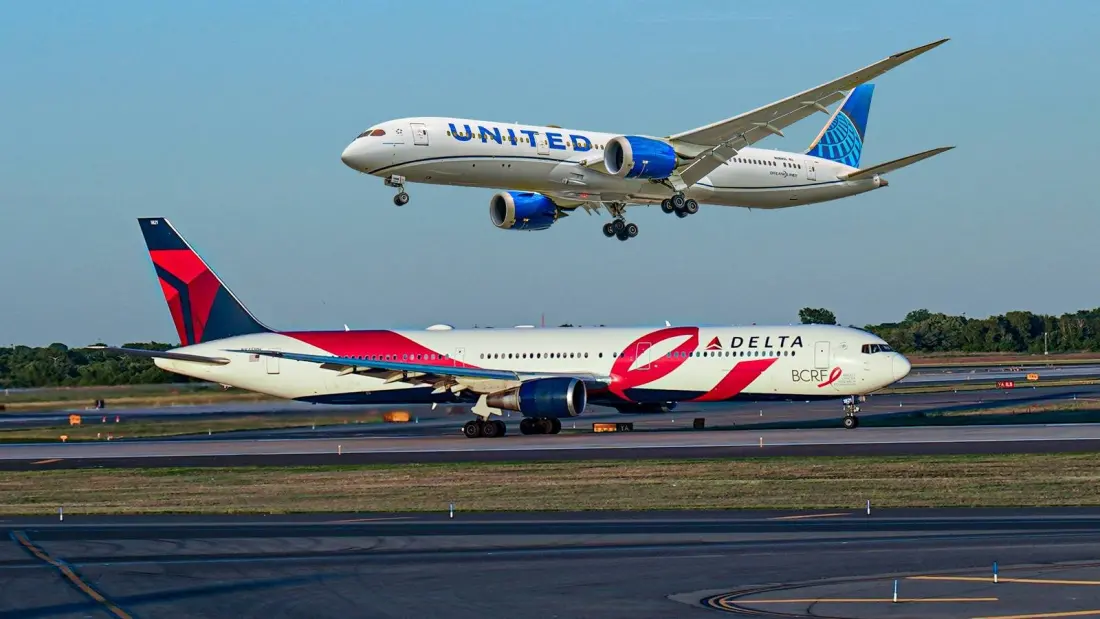
Counterintuitive but true: the newer, roomier widebody often gives economy passengers less seat width than the plane it replaced. Boeing's 787 Dreamliner fuselage is two feet five inches wider than the 767's, yet on most airlines you'll get a narrower seat aboard the newer jet.
The numbers explain why. The 787's cabin stretches 18 feet across the interior, versus 15 feet 6 inches on the 767. Boeing originally envisioned eight-abreast economy seating (2-4-2) on the Dreamliner, but nearly every carrier chose to squeeze in nine seats per row in a 3-3-3 layout. The 767, meanwhile, typically seats seven across in a 2-3-2 pattern, meaning just one middle seat per row — a rarity on any widebody. United illustrates the gap well: economy seats on its 787s run roughly 16.6 to 17.6 inches wide, while its 767s offer 18.0 to 18.5 inches.
The Dreamliner wins almost everywhere else. Launched in 2004 and entering service with All Nippon Airways in 2011, the 787 is built roughly 50% from carbon fiber composites, which don't corrode. That allows higher cabin humidity (15-25% versus below 10% on the aluminum 767) and a lower cabin altitude of 6,000 feet versus around 7,000-8,000 feet — both of which reduce dehydration and jet lag on long flights. Add a claimed 25% fuel-burn improvement and ranges up to 8,300 nautical miles on the 787-9, and the newer jet dominates on efficiency and comfort technology.
The 767, a 1970s design that first flew commercially with United in 1982, is fading from passenger service but retains a loyal following among economy travellers for exactly one reason: seat width. With 1,380 767s delivered against 1,322 787s, plenty of both are still flying.
There's one big exception to the cramped-Dreamliner trend. Japan Airlines configures its 787 economy cabins eight-abreast in a 2-4-2 layout, handing passengers an extra five centimeters of seat width — about 18.9 inches versus 17.7 inches on its own 767s. If seat width matters to you, JAL is the standout choice for Dreamliner long-hauls. Otherwise, check the layout before booking: a 787 flight with 3-3-3 seating offers a better cabin environment but a tighter seat than many 767s still plying the same routes.
The practical takeaway for economy travellers: the aircraft type on your booking is worth a glance, not just the price. A 2-3-2 767 or a JAL-style 2-4-2 787 will feel noticeably roomier across the shoulders than a standard 3-3-3 Dreamliner — and seat pitch varies by airline too, so it pays to look up the specific configuration rather than assuming the newer plane means more space.