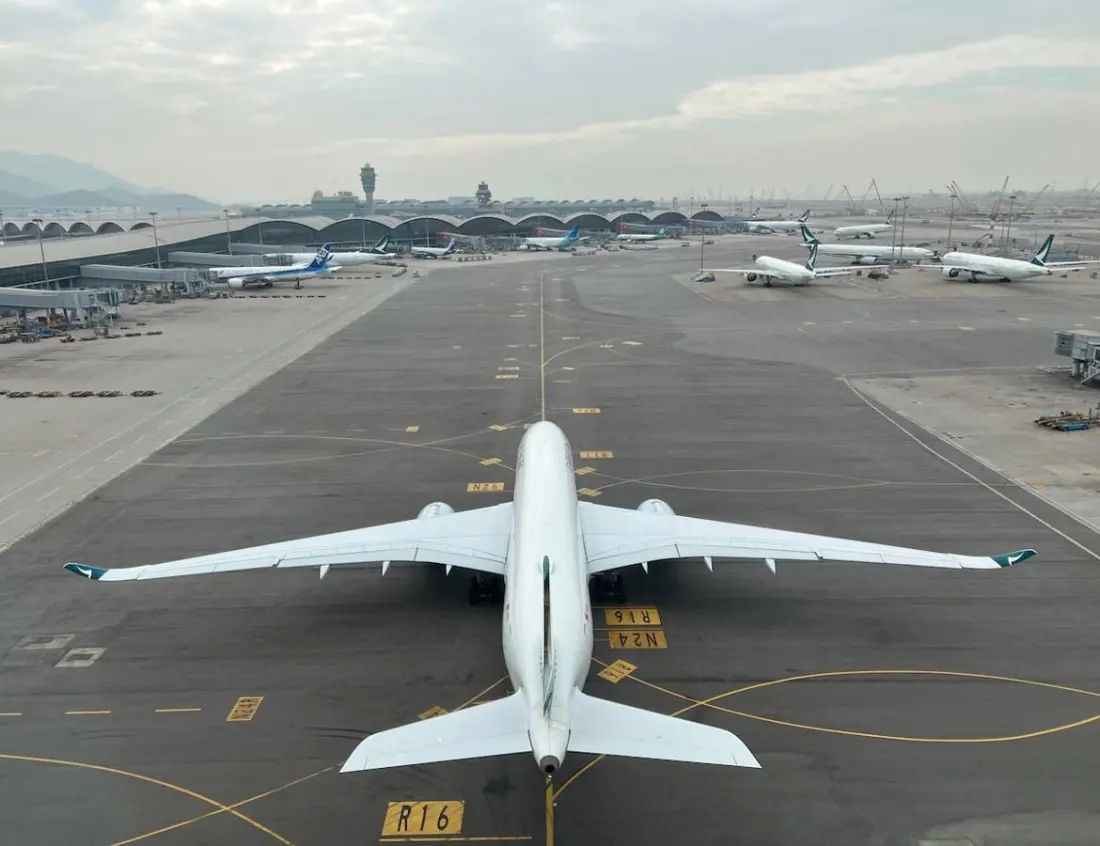
Ever found yourself at an airport window squinting at a jet and wondering if it's a 737 or an A320? You're not alone — plenty of people fly weekly and still couldn't pick a 787 out of a line-up. The good news is that identifying commercial aircraft is mostly about memorising a handful of visual cues, and a recent guide from One Mile at a Time breaks down the lot.
Start with Boeing's workhorse, the 737. Its outermost cockpit windows slope upward at the bottom, and the tail joins the fuselage with a long, gentle slope. Want to know if it's the newer MAX? Look for serrated chevrons on the back of the engines, split winglets with flat edges, and perfectly round engine inlets — the older NG has oval-shaped ones. Counting exits over the wing separates the variants: one per side means a 737-700, two means an -800 or MAX 8, and an extra door plug near the rear gives away the -900 or MAX 9.
Over at Airbus, the A320 family is trickier. The neo version has noticeably larger, more "open" engines than the older ceo. Among variants, the A319 usually has one overwing exit per side, the A320 has two, and the stretched A321 adds extra exits or oddly spaced windows at the back. The A220, meanwhile, is easy: it has just four cockpit windows (like the 787), a longer straighter nose, and tall, straight winglets.
The widebodies have their own tells. The 747 is unmistakable thanks to its partial upper deck; the -400 has upward-angled winglets and seven windows behind the upper deck exit, while the -8 has rising wingtips and fifteen. The 777 sports two massive engines, no winglets, fourteen wheels, and a flat, boxy tail cone. Confusing a 767 with a 777? Count the main gear wheels: four per side on the 767, six on the 777. The 787 is the simplest of all — chevron-shaped engine cutouts, gracefully swept wings, and it's the only widebody with four cockpit windows. Length separates its variants: roughly 186 feet for the -8, 206 for the -9, 224 for the -10, or just count windows between the front doors.
A couple more shortcuts worth pocketing. The 757 is a long, pencil-thin narrowbody with ten wheels — most narrowbodies have six. Its -300 variant looks absurdly stretched and carries an extra rear exit. And if a twin-engine widebody has the most classic-looking upward winglets in the business, you're probably looking at an A330.
Why bother? Beyond the simple fun of it, knowing your aircraft changes how you book and fly. You'll know when that "same flight" has been swapped to a tighter plane, when you're getting a quiet A220 or a roomy 777, and you'll never again stare blankly at a gate agent's answer about equipment. For anyone with a window seat and a spare moment on the tarmac, this is a genuinely handy party trick.