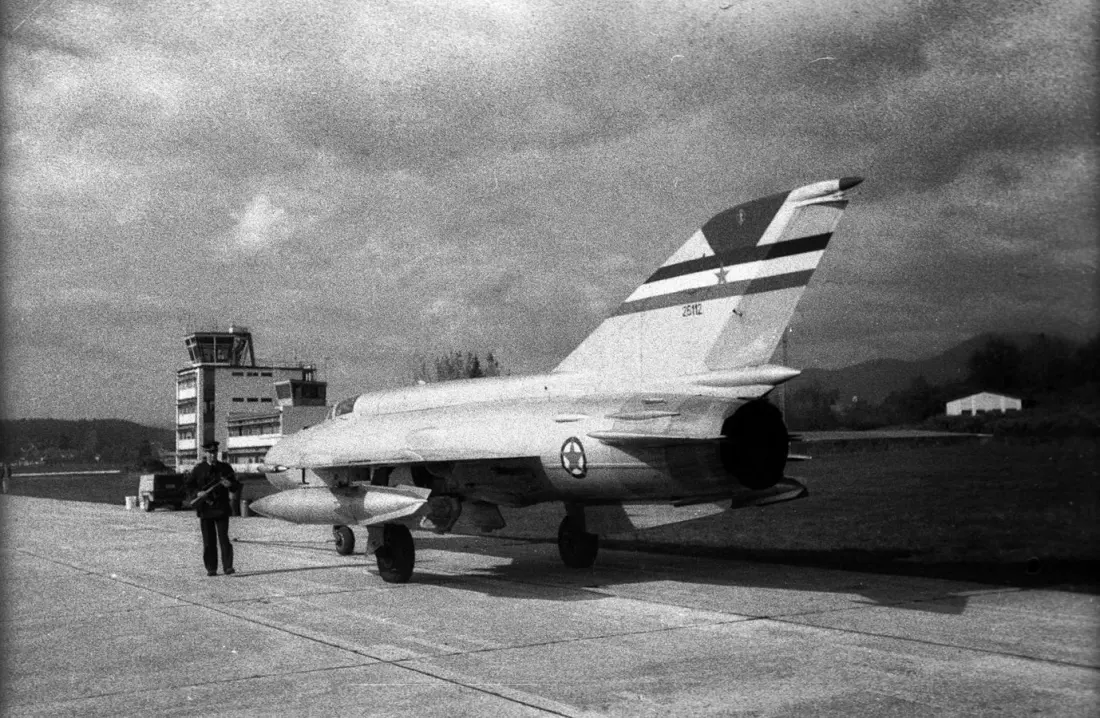
On 25 October 1991, a Yugoslav Air Force pilot pointed his MiG-21 towards Austria and flew out of a war he refused to fight. Rudolf Perešin had taken off from the JNA base in Bihać and landed the fighter jet in Klagenfurt, where he delivered the line that made him famous: "I am a Croat and I won't shoot at my own people."
The defection landed at a charged moment. Yugoslavia was fracturing, Croatia's independence war was underway, and the JNA was the very force many Croatian pilots were expected to serve. By flying out — and by publicly declaring why — Perešin turned a stolen fighter into a symbol of resistance. Austria kept the aircraft, and it stayed on display in a Klagenfurt museum for decades. It was only returned to Croatia in 2019, and today the MiG-21 sits in Zagreb as a monument to one of the defining moments of the Croatian Air Force.
Perešin's story didn't end with the defection. He joined the Croatian armed forces almost immediately, rising to command the 1st Fighter Squadron and flying combat missions through the Homeland War. His luck ran out on 2 May 1995, during Operation Flash in western Slavonia, when his aircraft was hit and he ejected over enemy-held territory. He was captured and killed. His remains were recovered only on 4 August 1997, and he was buried with full military honours at Mirogoj Cemetery in Zagreb that September.
For visitors to the Croatian capital, the story has a physical footprint worth seeking out. Mirogoj Cemetery — where Perešin is buried — is one of Zagreb's most striking sites in its own right, an arcaded 19th-century cemetery that doubles as an open-air gallery of Croatian history. The MiG-21 he flew to Austria is now exhibited in Zagreb, a tangible piece of the war that shaped modern Croatia. Travellers interested in the region's recent past will find the 1991–95 Homeland War woven through museums, memorials and cemeteries across the country.
Why does a three-decades-old defection still matter to holidaymakers? Because Croatia isn't just beaches and Game of Thrones backdrops. The country's independence — and its identity — was contested in living memory, and figures like Perešin are central to how Croatians understand it. A morning spent at Mirogoj or with the displayed jet adds real depth to a Zagreb stopover, and it costs nothing beyond your time. If your trip leans towards history and culture rather than coastline, this is the kind of story that turns a city break into something memorable.