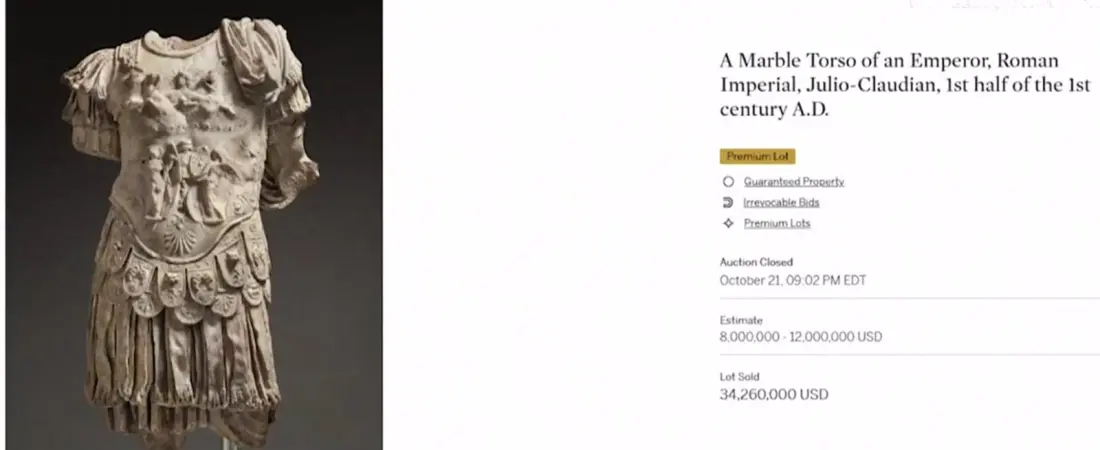
A marble torso of a Roman emperor, carved in the first half of the first century and traced back to the ancient city of Salona near Split, has just gone under the hammer in New York for more than $34 million. That figure makes it the most expensive Roman antiquity ever sold at auction, and it came after just 15 minutes of bidding — nearly triple the starting estimate.
The story is remarkable on several levels. When the same torso last appeared at auction in 2010, it fetched seven million dollars against an estimate of just one to one-and-a-half million. Dražen Maršić of the University of Zadar's archaeology department admitted he was stunned by the escalation. Croatia's Ministry of Culture and Media considered stepping in, but minister Nina Obuljen Koržinek said the price exceeded the entire budget for building and equipping a new museum. With the piece legally exported generations ago — an ancestor of its former owners bought it from a collector in Split around 1857 — there was no legal basis for restitution. The buyer's identity is unknown, though officials hope to borrow the torso for an exhibition in Croatia one day.
The most intriguing detail for anyone who has wandered the ruins of Salona: experts believe the emperor's head may still lie in Croatian soil. Maršić notes a realistic chance it was buried, either lost in an archaeological context or deliberately hidden, as happened with Roman sculptures during the early Christian era when pagan imagery was often interred.
The torso wasn't Croatia's only auction headline that week. In Vienna, Vlaho Bukovac's painting "Pink Dream" sold for close to half a million euros, setting a record as the priciest Croatian painting ever sold at official auction.
Why should travellers care? Because Salona itself is one of the most under-visited major Roman sites in Europe. A short drive from Split's Diocletian's Palace, it was the capital of the Roman province of Dalmatia and home to tens of thousands of residents — yet it rarely features on first-time itineraries. A headline like this raises its profile, and there's a genuine romance to the idea that a missing imperial head could still surface there. If you're heading to Dalmatia, pairing Split's UNESCO-listed palace with an afternoon among Salona's amphitheatre ruins, early Christian basilicas and city walls makes for a compelling Roman double-header. Just don't expect to see the torso on Croatian soil any time soon — it now belongs to an anonymous buyer, reportedly worth more than a museum.