Greece packs a lot into a small space. The country is roughly 75 times smaller than the United States, yet it gave the world history as a discipline, plus philosophy, poetry, democracy and drama. Its visual language has proven just as durable — and the Greek key, that square, maze-like motif you've probably seen on everything from jewellery to hotel floors, is having another moment.
The pattern has a proper name: the meander, borrowed from a famously winding river in Anatolia. Its repeating line appears on ancient Greek pottery, temples and jewellery, and because it never really went out of style, designers keep reaching for it. It reads as classical without feeling fussy, geometric without feeling cold — which is exactly why it slots so easily into modern interiors and accessories.
Recent examples show how wide the range is. A circular metal wall art piece plays on the sun while hiding the meander in its centre. Versace has embossed its Icaro leather sneakers with hand-painted Greek detailing and, inevitably, a Medusa head. Luke Edward Hall painted a tableware collection for the Florentine porcelain house Ginori 1735 — Il Viaggio di Nettuno — with an undersea deity from Poseidon's orbit. ZahriGold turns the motif into an 18-karat gold-plated stainless steel bangle, and a blue-and-white Greek key vase appears in the Jonathan Adler x Michaels home decor collection, proof the look has reached the high street. Even American furniture designer Michael Taylor used the pattern for Greek Key armchairs in his Far East collection for Baker Furniture — a nod to the fact that the meander travelled widely across ancient cultures, not just around the Aegean.
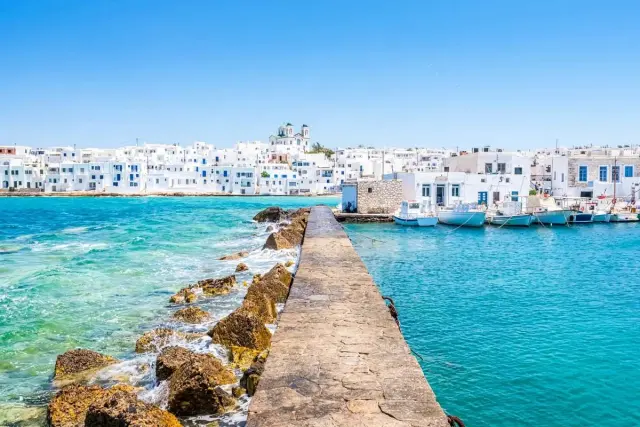
For travellers, the appeal is obvious: it's the rare souvenir aesthetic that doesn't scream 'souvenir'. Instead of a fridge magnet, you can bring home the visual DNA of Greece — a bangle, a plate, a piece for the wall — and it will look as at home in a London flat as it would in a taverna on Paros. It also doubles as trip inspiration. Once you start noticing the meander, you'll spot it all over Athens and the islands, from marble floors to ferry interiors, a quiet reminder that what we call 'classic' usually means Greek.
So if you're planning a Greek holiday and want to take a piece of the country's design heritage with you, skip the trinket stalls and look for the key. It has survived roughly 3,000 years of fashion cycles already; your odds of still liking it next year are decent.