
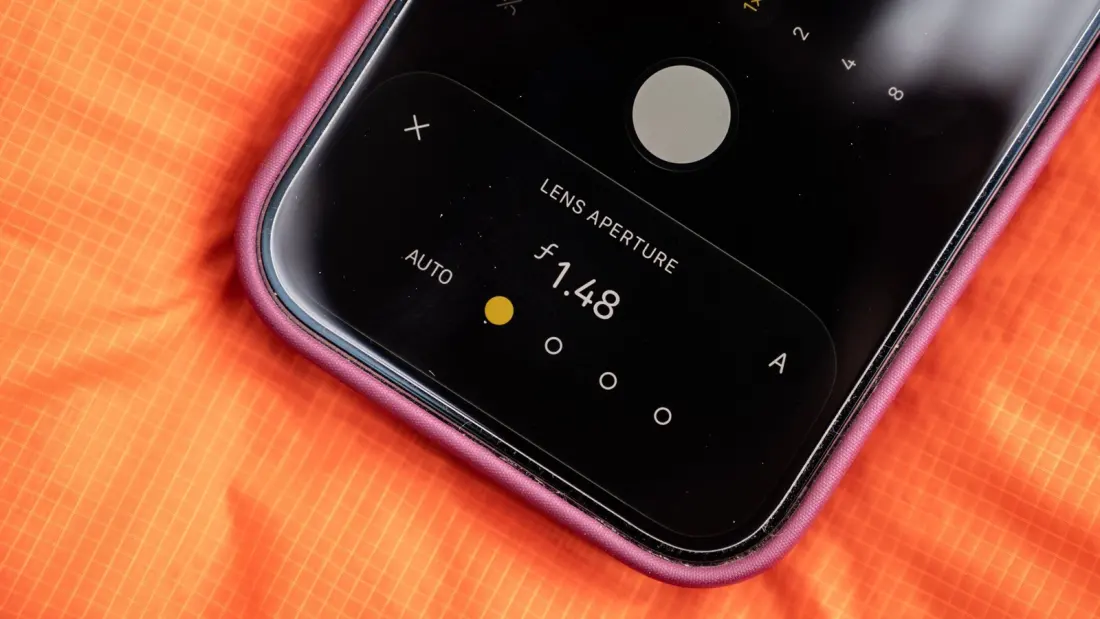
Phone cameras have always faked it. Software could blur a background, but the lens itself had one fixed amount of light it could take in. The iPhone 18 Pro and Pro Max, released this September, finally change that: the main 48-megapixel, 24-millimetre lens has a mechanical iris you can actually adjust — a first for any iPhone.
In the camera app you can pin aperture and shutter controls to the top of the screen and dial in four aperture settings: f/1.48, f/1.8, f/2.8 and f/4. That range looks narrow, but the iPhone's small, lens-hugging sensor means f/4 already delivers near-infinite depth of field, and Apple stopped at f/1.48 because anything wider would have bulked up the lens. And unlike the f-stop slider on recent iPhones — which merely simulates depth of field with digital blurring — this is real light control. At f/1.48, the widest aperture ever on an iPhone, low-light shots hold together far better than on the iPhone 17's fixed f/1.78 lens, and the phone behaves like the aperture-priority mode on a proper camera, adjusting shutter speed for you.
Manual shutter control is new too. Set a fast speed to freeze a moving subject and the phone sorts the exposure; drop the shutter for a panning shot of, say, a moving tuk-tuk or cyclist, and you can narrow the aperture to compensate. There are limits — at f/4 the image blew out whenever the tester slowed the shutter past 1/30th of a second — but it still shot better motion photos than any previous iPhone. Rounding out the upgrades: subject tracking (tap a person and the camera locks on as they move — think kids on a beach or a football pitch), plus manual focus with focus peaking that outlines what's sharp in white.
Practical quirks worth knowing: the manual controls are awkward one-handed in portrait orientation, so you'll mostly shoot with two hands and horizontally. And it's slower than a mirrorless camera, though a workflow develops with practice.
Who should actually buy it? If you're happy with an iPhone 16 or 17 Pro and never touch manual settings, skip this one — image quality is similar. If you already carry a mirrorless or DSLR and don't mind the weight, that still wins. But for travellers who want DSLR-style control without packing a second camera, the 18 Pro is now a genuinely compelling all-in-one: one device for navigation, bookings and photos that can genuinely see in the dark.
For holiday shooters, the takeaway is simple: the gap between 'phone photo' and 'real camera photo' just narrowed another notch — especially after sunset, at dusk markets, or anywhere the light gets tricky.
Reviewed and road-tested by Outside Online.