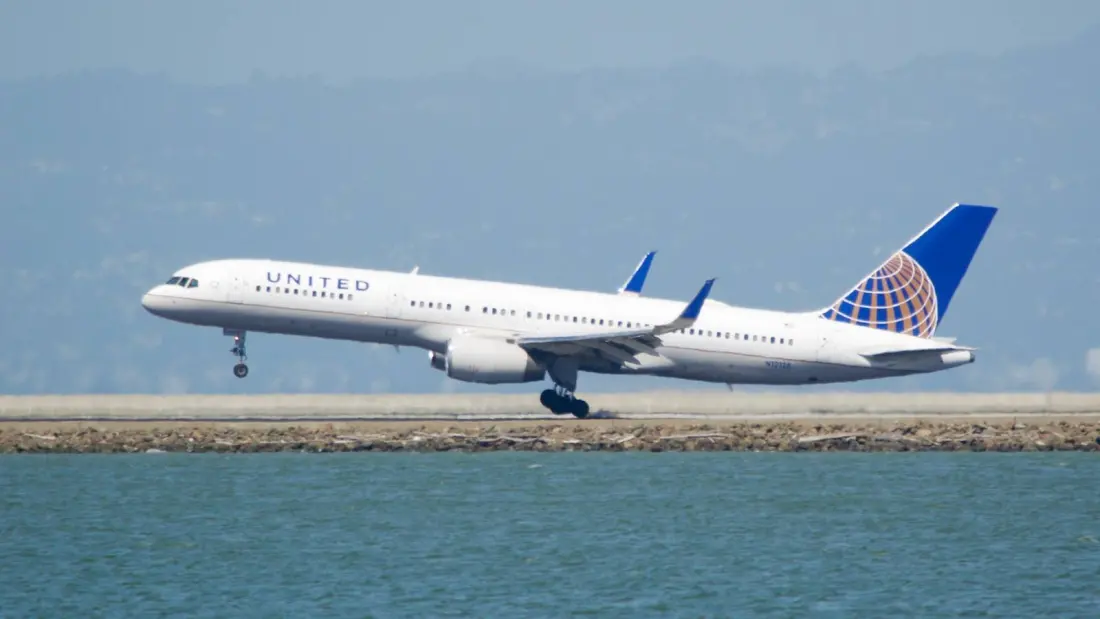
A transcontinental United flight had a tense few minutes at San Francisco International Airport on Friday, October 30, when an aborted landing left the crew burning closer to minimum fuel than anyone would like.
The aircraft, a Boeing 757-200 registered N19117, was operating flight UA1023 from Boston Logan with 91 passengers and six crew on board. Cleared to land on Runway 28R at 11:11 AM, the crew abandoned the approach at around 75 feet after deciding the approach was unstable. Air traffic control had already flagged wake turbulence from a Boeing 787 that had touched down just ahead, plus a light five-knot tailwind — though it's unclear whether either played a role.
With the jet back in the air, the crew radioed "Mayday, Mayday, Mayday, fuel emergency," climbed to 5,000 feet and reported roughly 5,200 lbs of fuel remaining — close to the minimum reserve for a 757-200. Priority handling followed: the aircraft was cleared for a second approach to the same runway and touched down safely at 11:24 AM, about fourteen minutes after the go-around. No injuries were reported.
Here's where it gets interesting. United later told Simple Flying that "the crew did not declare an emergency," despite the clearly recorded Mayday call — and the plane never changed its transponder to an emergency squawk code. That's less contradictory than it sounds: the squawk change is standard practice but not strictly required once a crew has spelled out the situation by radio. Whether to declare an emergency over low fuel ultimately sits with the pilots.
It's also a useful window into how these situations work. "Minimum fuel" is the gentler alert — it tells controllers no further delays are acceptable. "Mayday" is the escalation, signalling the aircraft needs immediate priority. Neither necessarily means the tanks are seconds from dry; it means the fuel state demands attention now. FAA rules require US carriers on domestic flights to carry enough fuel for the destination, an alternate where needed, plus 45 minutes of flying — so a crew should never be truly on fumes unless multiple things go wrong.
Notably, this came just five days after another United scare: on October 25, flight 1854 from Grand Cayman to Houston declared an emergency after its right main landing gear failed to extend, with pilots reporting just 10 to 12 minutes of fuel left. That one also ended safely.
For travellers, the takeaways are reassuring rather than alarming. Go-arounds happen regularly and are usually routine; the system — from reserve fuel rules to controllers clearing a priority approach — is built for exactly this. If you're ever on a flight that aborts a landing, it typically means a few extra minutes in the air, not danger.
Story via Simple Flying.