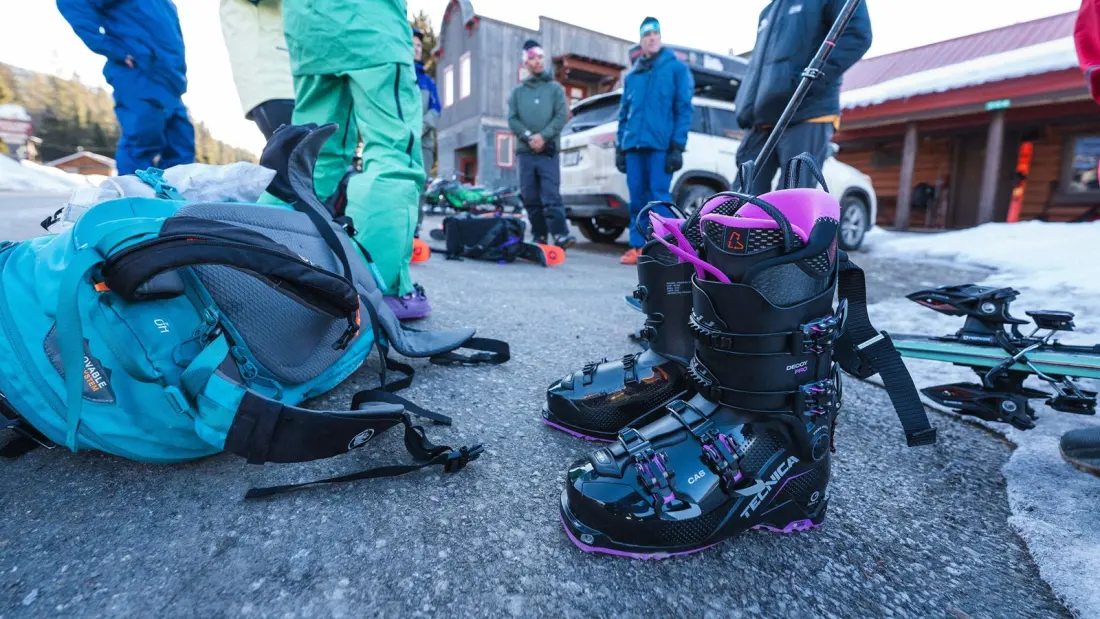
Ski touring boots come in two flavours the industry loves: featherweight two-buckle racers built for the up, and sturdy four-buckle crossover hybrids that ski like alpine boots. What's gone quiet is the middle. A recent Ski Magazine column by former ski-shop staffer Bergen Tjossem argues that the midweight touring boot — historically three buckles, roughly 1,300 to 1,500 grams — is the class most skiers actually need, and the one brands have stopped investing in.
The maths is simple. Backcountry skis cluster on a neat bell curve of width and weight, but boots are sold at the extremes. Lightweight models like the La Sportiva Kilo (two buckles, around 1,200 grams) climb brilliantly but lack the flex and damping to drive a wide ski in crud. Crossovers such as the Dynafit Tigard or Scarpa's 4-Quattro XT — which shook up the segment in 2022 with a genuine 61 degrees of walk-mode range at 1,500 grams — overpower narrow skis and overlap awkwardly with the alpine boots many skiers already own. A true midweight handles the whole ski quiver.
Tjossem's own gear cupboard tells the story. He keeps reaching for his worn 2023 Scarpa Maestrale RS, the archetypal workhorse, even when the specialist boots look tempting. The irony: even the Maestrale line is drifting heavier this season, adding a fourth buckle and nudging up a class. Meanwhile the lightweight category boomed through the 2010s ski-touring explosion, resort uphilling and skimo racing, and the crossovers got the next wave of research dollars chasing the huge resort-hybrid market.
Boots in the mid slot do still exist — the Scott Cosmos Pro and Fischer Transalp get namechecks — but the writer's point is that they're stale, running on a formula the Scarpa Maestrale essentially nailed sixteen years ago: three buckles, a camming power strap, big walk range, low fiddle factor. Nobody is seriously competing to refine it with modern materials.
Why should a holiday skier care? If you're building a first backcountry setup, or adding one touring boot to a resort quiver, the advice embedded here is genuinely useful: don't assume newer and lighter is better, and don't let a shop talk you into a race boot or a crossover if your skis sit in the middle of the spectrum. A three-buckle midweight in the 1,300-to-1,500-gram range will ski almost everything you'll find on a typical backcountry day, from powder bowls to wind-crusted traverses, without wrecking your ascent. If you already own a pair, look after it — refreshing your midweights may be harder than replacing them. And if you're shopping this winter, compare the Scott and Fischer options against whatever hybrid the sales floor is pushing; the 'best' boot is the one that matches your ski, not the category with the biggest marketing budget. Skiers who want a modern take on the classic formula may need to wait for the industry to notice the gap — or, like the author, cling to a well-loved pair until someone builds the missing middle properly.