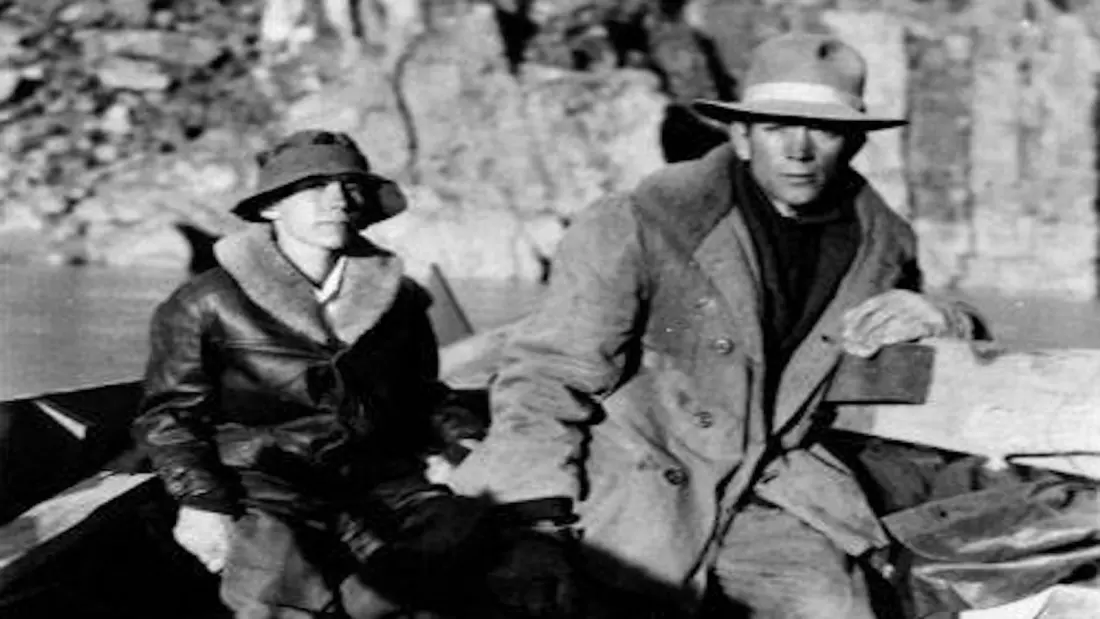
In October 1928, a young couple launched a homemade wooden boat onto the Colorado River to chase a world speed record through the Grand Canyon. Within weeks, Glen and Bessie Hyde were gone. Their 20-foot scow, Rain-in-the-Face, was found upright and fully loaded — cameras, diaries, everything — near river mile 237. Only the Hydes were missing. Neither body was ever recovered.
Glen, 29, was a seasoned outdoorsman who had rowed Idaho's Salmon and Snake Rivers. He met Bessie, 22, on a passenger ship off California in 1925, married her the following April, and six months later they set off from Green River, Utah. Completing the run would have made Bessie the first woman to paddle that stretch of the Colorado — a title she partly claims anyway, as the first woman to run Cataract Canyon and much of the canyon.
Historian Peter Runge of Northern Arizona University believes the clues point to the water itself. November in the Grand Canyon brings freezing nights, wind, rain, even snow. The Hydes wore heavy leather, wool and fur — fine on land, deadly soaked — and no life jackets. Worse, Glen's scow was a Pacific Northwest freight design, built for calm water, with sweeping oars at bow and stern that steered rather than propelled. On the undammed, far wilder 1928 Colorado, Runge suggests it likely struck a submerged rock and threw them both out. "The scow is almost as if it's a coffin without a lid," he told Outside.
The vacuum of answers has bred theories. In 1971, an Oklahoma woman named Elizabeth Cutler claimed to be Bessie, saying she'd stabbed her husband and hiked out — she later recanted. A legend grew around pioneering river runner Georgie White after the Hydes' wedding license surfaced among her effects, though the timeline doesn't fit. And when a skeleton with a bullet in its skull turned up in the garage of canyon photographer Emery Kolb — who took the couple's last known photo on November 18, 1928 — speculation flared again, only to dead-end.
Nearly a century on, the story survives because Grand Canyon river guides never stop telling it. Runge, who has rowed the Colorado himself, says storytelling is part of the trip experience. For modern travellers, the contrast is stark: today's standard run covers 277 river miles from Lee's Ferry to Diamond Creek or Pearce Ferry over 14 to 26 days, through roughly 250 graded rapids, with professional guides, drysuits and life jackets. What killed the Hydes, most likely, is exactly what modern outfitting exists to prevent.
Why care? Because rafting the Colorado is on plenty of bucket lists, and its history — triumphs and tragedies alike — is woven into every rapid. The Hyde mystery is the story you'll hear drifting between Lava Falls and Horn Creek, told by the people whose skill keeps the river's dangers at bay.