
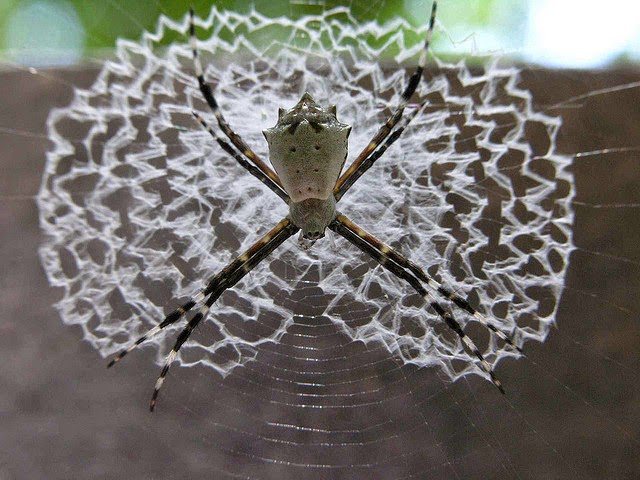
Some orb-weaving spiders don't stop at a functional web. They add extra structures — bright, patterned silk formations known as stabilimenta — that make their already intricate webs look deliberately decorated. Featured by the nature site Ark in Space, these embellished webs are among the more striking sights in the small-world corners of gardens and forest edges.
The decorations aren't just for show, or at least scientists think so — their exact purpose is still debated, with theories ranging from camouflage and prey attraction to warnings for large animals (like us) not to walk face-first into the silk. Whatever the function, the visual effect is unmistakable: zigzags, spirals and dense silk bands woven right into the web itself, most famously by Argiope species such as the Banded Garden Spider.
There's a literary twist too. The writer E.B. White, stuck for ideas on his second novel, noticed the stabilimenta on a Banded Garden Spider's web and began to imagine a spider that could write. That observation grew into Charlotte's Web, first published in 1952, one of the best-loved children's books ever written. The 'writing spider' of the novel has a real-life counterpart: in parts of the United States, Argiope aurantia is still called exactly that because of the thick, letter-like silk bands in its web.
Why cover it here? Because the natural world keeps handing travellers quiet rewards that cost nothing. Keep an eye out on early morning walks in gardens, meadows and parkland — dew-laden webs with silk zigzags across the centre are a good sign an Argiope is nearby, and they photograph beautifully in low light. You don't need a jungle expedition; these spiders turn up in ordinary hedgerows across North America, Europe, Asia and Australia. It's also a nice one for travelling families: a kids' book many will know, connected to a real creature they can actually spot.
For the full set of photographs and the longer story behind the webs, the original feature on Ark in Space is worth a look.