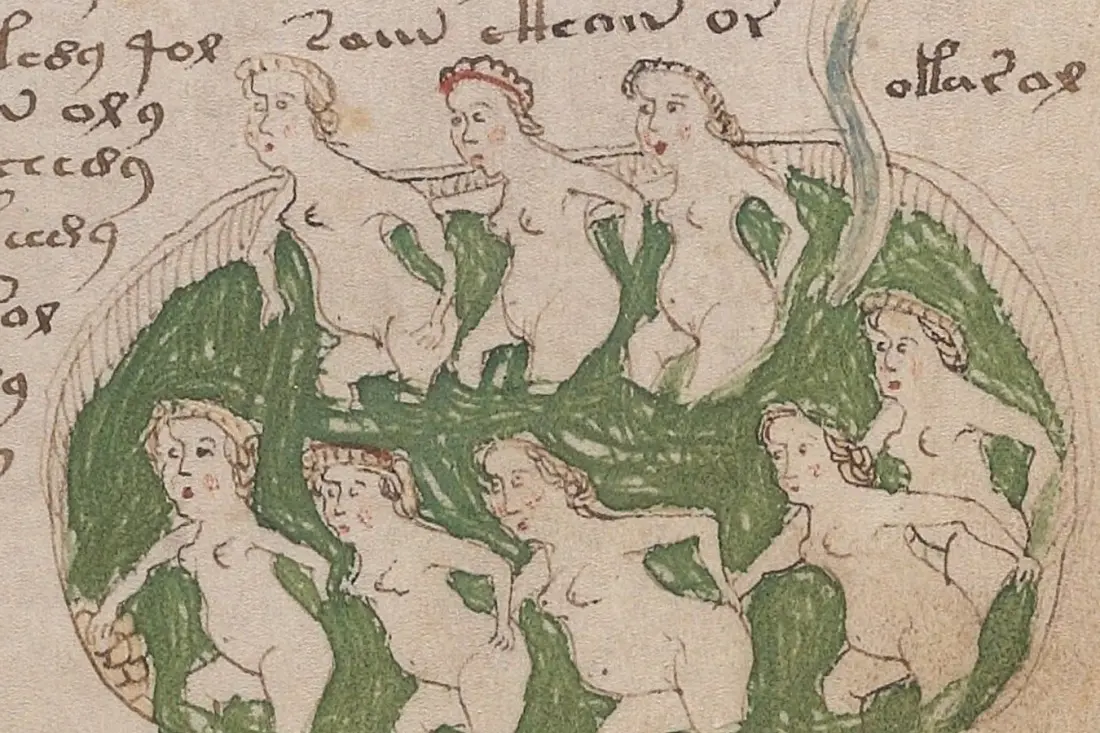
The world's most stubborn book puzzle just got a fresh twist. A new study argues that the Voynich manuscript — the 15th-century codex full of unreadable script and strange drawings, held at Yale University — may have been assembled from its pages in the wrong sequence, and that computing tools can help work out what the original order was.
The research, published in Digital Medievalist, comes from Lisa Fagin Davis, executive director of the Medieval Academy of America, and Colin Layfield, an information systems researcher at the University of Malta. Their proposal: rather than being built from conventional quires (nested groups of folded sheets), the manuscript began life as single folded sheets, each making two leaves — known as singulions. Someone later bound these together into the book we have today, scrambling the intended arrangement.
The pair combined physical evidence with statistics. Several illustrations appear to run off one page and continue on another sitting far away in the current binding, and the text shows distinct handwriting styles that sit awkwardly side by side in the surviving order. On the computational side, they used latent semantic analysis (LSA), which compares word and pattern similarities across texts without needing to understand the language — handy when nobody can read yours. They calibrated the method against known medieval manuscripts, and the analysis points to clearer candidate sequences for quires 13 and 20, though the first eight quires may never have a single definitive order.
Not everyone is convinced. Voynich researcher Torsten Timm accepts that pages from the same physical sheet show heightened textual similarity, but questions whether that proves any intended reading order — similar vocabulary, he argues, doesn't automatically mean pages belong side by side. The team's next test is suitably low-tech: comparing the shape of a large water stain along the upper margins across pages, since a stain that doesn't line up symmetrically could reveal how the sheets were originally arranged.
A quick primer for the uninitiated: the manuscript is named after Wilfrid Voynich, the bookseller who bought it from a Jesuit collection in Italy in 1912. Radiocarbon dating puts the parchment between 1404 and 1438, though that dates the material, not necessarily the writing. Its author, language and origin remain unknown, and its drawings — unidentifiable plants, astronomical diagrams, bathing figures, what look like herbal or pharmaceutical notes — have fuelled a century of theories. A letter from 1665 claims Holy Roman Emperor Rudolf II bought it for 600 gold ducats, but that's the only account of the sale. Today it lives at Yale's Beinecke Rare Book & Manuscript Library as MS 408, and the library offers free high-resolution scans online, so you can pore over every baffling page yourself.
Why it matters to travellers: if the page order really is scrambled, decades of decipherment attempts built on the current sequence may need a rethink — and the Beinecke, where the real thing is displayed and where visiting exhibitions rotate, becomes an even more compelling stop for anyone fascinated by medieval mysteries. Nobody has cracked the code yet, but Davis is optimistic: with more computing power and interdisciplinary collaboration, she believes "we'll get there."