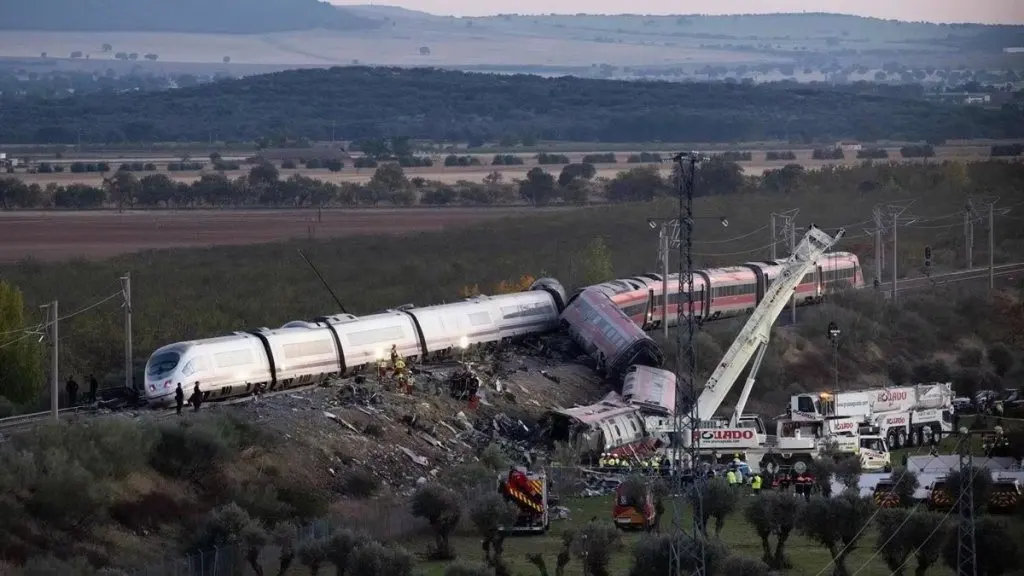
The judge leading the investigation into Spain's deadly rail disaster near Urda has ordered a crane company to supply more workers and set up proper shift rotations, after a shortage of staff forced crews to stop removing wrecked carriages overnight. The work had been meant to continue through Sunday night, but there were not enough employees from the firm contracted by track operator Adif and Renfe to keep the site running. Recovery resumed on Sunday morning.
The collision near the village of Urda, in Castilla-La Mancha's Toledo province, killed 69 people when it happened on Wednesday. Forensic teams have so far identified 56 of the dead: 54 Spanish nationals, one French citizen and one Portuguese. Autopsies have been completed on all victims, and relatives are giving DNA samples to help complete identifications. Many families are still waiting for news.
The casualty numbers are slowly improving. Regional authorities said 31 injured people remained in Castilla-La Mancha hospitals, 13 of them in intensive care, with another 10 in Madrid-region hospitals. In total, 232 people have been treated for injuries since the crash.
The surrounding community is grieving visibly. On Saturday, a memorial Mass at Urda's San Juan Bautista church filled the pews, with dozens more standing outside. The Archbishop of Toledo, Francisco Cerro, told bereaved families that words could offer no comfort but that they were not alone, and he thanked emergency workers and volunteers for what he called a genuine wave of solidarity. Castilla-La Mancha's president Emiliano García-Page and Urda's mayor Manuel Galán attended. Galán said residents of the village of around 2,500 people were in great pain and in great need of support.
The crash has also escalated politically, with the transport minister describing a decision to let the high-speed train proceed before the collision as inexplicable, and the investigation examining control-room orders and safety failures. For now, though, the immediate focus remains on recovering and identifying every victim — and on why a shortage of crane crews slowed that work overnight.
This is developing news coverage rather than a holiday story, but it matters to anyone travelling by rail in Spain, where the high-speed network is a backbone of domestic tourism. Renfe and Adif operations in the Toledo area may be affected as the investigation continues.