A cracked part buried deep inside the General Electric GE9X engine could have quietly derailed Boeing's 777X programme. Instead, engineers say a redesigned component will keep the first version of the jet, the 777-9, on track for delivery in 2027 to launch customer Lufthansa.
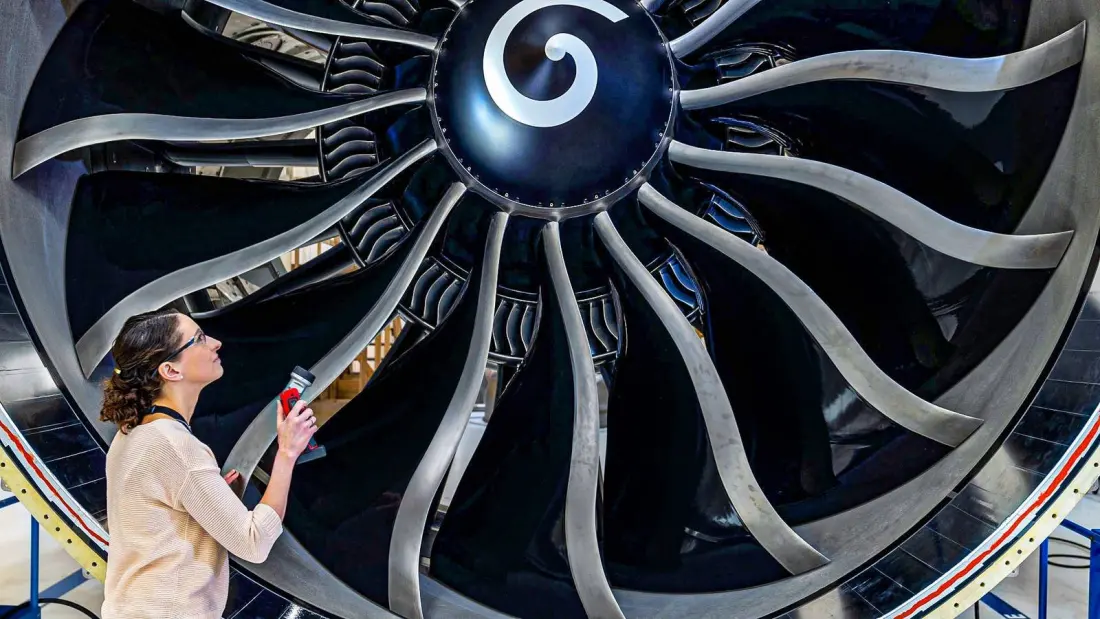
The crack turned up during an inspection in January 2026, and the component in question — the mid-seal, which sits between turbine stages and manages pressure and temperature differences — is small. But the reason it failed is anything but small: the GE9X's fan measures 134 inches (3.4 metres) across, the largest ever fitted to a commercial aircraft. That size is what gives the engine its roughly 10% fuel-efficiency gain over the previous GE90, but it also forces the engine's core to run hotter and at higher pressures than any rival, pushing materials close to their limits. GE says the engine is rated at 110,000 lbs of thrust but has demonstrated up to 134,300 lbs in testing.
This is not the engine's first stumble. There were compressor vane durability problems in 2019, a temperature alert that paused flight testing in 2022, and a grounding in 2024 after titanium thrust link failures. The programme has nonetheless racked up more than 30,000 test cycles and 1,600 dust-ingestion tests, and relies on advanced materials like ceramic matrix composites and 3D-printed metal parts to survive conditions no earlier engine has faced. Because the GE9X operates in a design space with little historical precedent, issues like this one tend to require redesigns rather than quick fixes.
For flyers, the 777X matters: it promises lower fuel burn and emissions on long-haul routes, and airlines have ordered it in bulk. Emirates alone has a staggering 270 on order (35 of the shorter 777-8s and 235 of the 777-9s), with Qatar Airways next at 90, followed by Cathay Pacific, Singapore Airlines, British Airways, ANA, Lufthansa, Korean Air and others. Certification flight testing continues, and neither Boeing nor GE expects the mid-seal issue to shift the 2027 entry into service. GE has confirmed the root cause is understood and the redesigned part is already moving into production.
So while this story is told in inches of fan diameter and turbine tolerances, the takeaway for travellers is simple: the next generation of long-haul flying is close, and the engines powering it are being stress-tested in ways the industry has never had to do before. Expect to see the 777-9 on European and Gulf carrier routes from 2027 — assuming the biggest fan in commercial aviation behaves itself.