Choosing between Asia's two trendiest capitals feels impossible, but there's a simple fix: they're only about 2.5 hours apart by direct flight, with multiple daily services. Plenty of travellers are now doing both in one trip — and for good reason. These cities offer completely different flavours of an Asian city break.
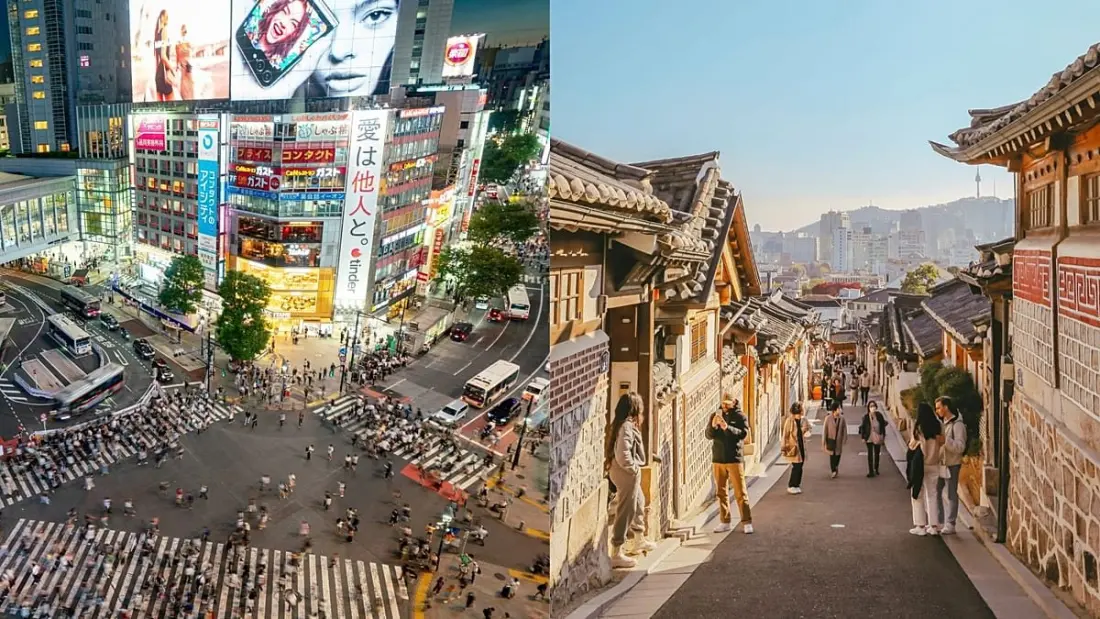
Tokyo remains the heavyweight. Japan's capital pulled in a record 28.65 million international visitors in 2025, and it's easy to see why. The scale is staggering — Shinjuku station, the world's busiest, handles over 2.7 million passengers a day across more than 200 exits (check your exit carefully or you'll wander for ages). Each district has its own personality: Shibuya's famous crossing and observation decks, Harajuku's street fashion, Akihabara's anime and electronics, Ginza's luxury shopping. For a slower pace, head to Asakusa's Sensō-ji, the city's oldest Buddhist temple, or Meiji Jingu shrine, where a wall of decorated saké barrels makes for a great photo. Food-wise, Tokyo leads the world in Michelin stars — including 11 three-star restaurants — but street food delivers memorable meals on a budget. With a spare day or two, the Fuji Five Lakes region by Lake Kawaguchi offers hot springs and views of Mount Fuji.
Seoul is the one on a serious upward run, powered by the global K-culture wave. A record 8.23 million overseas visitors arrived in the first half of 2026, up 21.3% year on year, and the city leapt 33 places to ninth in Time Out's 2026 ranking of the world's best cities — while its Jongno 3-ga neighbourhood was named the coolest on Earth, all late-night food stalls and rivers of makgeolli. It also topped the Trazees awards for Gen Z and Millennial travellers for a fifth straight year.
The Seoul highlights mix old and new: watch the changing of the guard at Gyeongbokgung Palace, then wander the traditional hanok houses of Bukchon village. Gangnam, Myeong-dong, Hongdae and the café-filled warehouse district of Seongsu cover the modern side. Eat your way through Korean barbecue, soju and chimaek — fried chicken with beer — and know that the city has 42 Michelin-starred restaurants. The Han River parks are great by bike or on a night cruise, Bukhansan National Park offers hiking within city reach, and a DMZ tour makes a strange but fascinating day trip.
So which wins? Tokyo for sheer size and endless exploring; Seoul for K-culture energy, food and cool neighbourhoods. Honestly, the better question is how many days you can squeeze out of both.