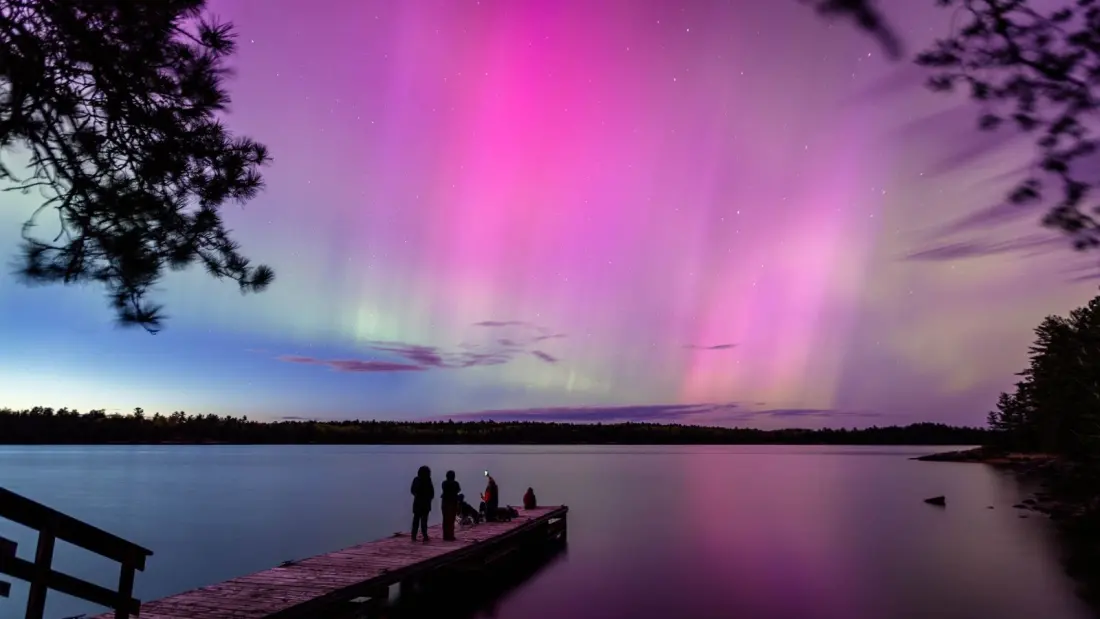
Voyageurs National Park in northern Minnesota has picked up DarkSky International's 2026 Dark Sky Place of the Year award, one of the top honours in night-sky conservation. It's a fitting pick: the park averages 21.45 on the sky quality scale (22.0 is a perfectly dark natural night), meaning on a clear evening the Milky Way isn't a faint smudge — it's the main event.
What earned Voyageurs the award isn't just its darkness, which it was certified for back in 2020. It's the outreach. Since then, the park and its nonprofit partner, the Voyageurs Conservancy, have brought roughly 8,300 students into its Virtual Dark Sky Classroom, drawn nearly 6,000 people to Park After Dark events, and hosted six Star Parties with over 1,300 attendees. Around 40,000 students nationwide join its Boreal Stargazing Week each year. For anyone who can't make the trip — and that's most of us, given 80 percent of Americans can't see the Milky Way from home, according to the National Park Service — those virtual programmes are a decent taste of the real thing.
The stargazing itself benefits from unusual geography. About 40 percent of the park's 218,000 acres is water — a network of glacial lakes — so there are no foothills blocking the horizon. On calm nights, roughly 30 lake surfaces act as mirrors, doubling the constellations. And unlike the Great Smoky Mountains, which pulls in 12 million visitors a year, Voyageurs sees about 200,000 annually. Crowds are not the problem here.
The award arrives during a rocky year for the region. Congress reversed a 20-year mining ban on roughly 350 square miles of Superior National Forest in April, reopening the door to proposed copper-nickel mines near the Boundary Waters. Voyageurs shares the Rainy River watershed with the Boundary Waters — together with Ontario's Quetico, they form one of the world's largest dark-sky regions — so pollution could travel far downstream. Minnesota's governor signed an order blocking copper mine permitting, but it expires after he leaves office. Wildfires also forced the million-acre Boundary Waters to close entirely in July, and Voyageurs banned campfires for six weeks.
The park has also done the unglamorous work: swapping outdoor fixtures for downward-facing, dark-sky-friendly lighting and routinely measuring sky brightness at five sites.
For travellers, the takeaway is simple. If you want a genuinely dark night sky in the Lower 48 without fighting for a viewpoint, Voyageurs is one of the best bets going — with the caveat that its future skies depend on how the mining question resolves. Winter brings a shot at aurora alongside the stars; summer brings canoe trips between viewing spots.