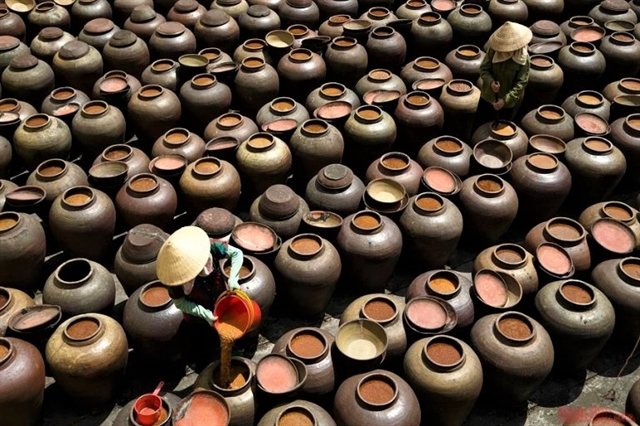
Ask around in Thái Nguyên province, north of Hanoi, and you'll hear about tea first. But locals in Phú Bình commune will point you somewhere more surprising: a jar of Úc Kỳ fermented soybean paste, a condiment with centuries of history and a growing reputation as the region's most distinctive souvenir.
The name comes from Úc Kỳ, a former commune whose villages have made soybean paste for generations — so long, in fact, that even village elders can't say when the craft started. Every household traditionally kept a jar for daily meals and for gifting guests. Today more than 200 households in the area produce and sell the paste, and it has picked up a three-star OCOP rating (a Vietnamese programme for rural speciality products) plus a spot among Thái Nguyên's 27 outstanding agricultural products.
The process is rustic but demanding. Three humble ingredients — Thầu Dầu glutinous rice, soybeans and white salt — go through stages that can't be timed by the clock. The steamed rice is spread on bamboo trays and left to develop a pale yellow layer of fungus, with makers judging progress by smell, colour and texture. Roasted, crushed soybeans soak in saltwater for roughly two weeks before joining the rice in an earthenware jar, which sits in the sun for more than two months of fermentation. Makers stir the mixture daily with a bamboo pole, sealing the jar after each round. The best jars, locals say, stay in the open air — warmed by day, cooled by night, in a kind of 'yin and yang' balance.
The result is a thick, golden paste with the consistency of runny honey: salty and savoury from the soybeans, gently sweet from the fermented sticky rice, and aromatic enough to need no extra seasoning. Locals use it as a dip for steamed vegetables, boiled pork, beef and fried tofu, or stirred into stews, soups and marinades for extra depth.
Production runs all year, though March to October is considered the ideal window, when sun and warmth help fermentation along. And you don't need to travel to Phú Bình to try it — farmers sell nationwide, and the paste is easy to find on Vietnamese e-commerce platforms and social networks. But if you're in Thái Nguyên, a jar straight from the source makes for a gift with a story behind it.
For food-focused travellers, this is a chance to taste something you won't find on standard restaurant menus — an everyday farmhouse condiment that locals have eaten for centuries and are only now sharing more widely.