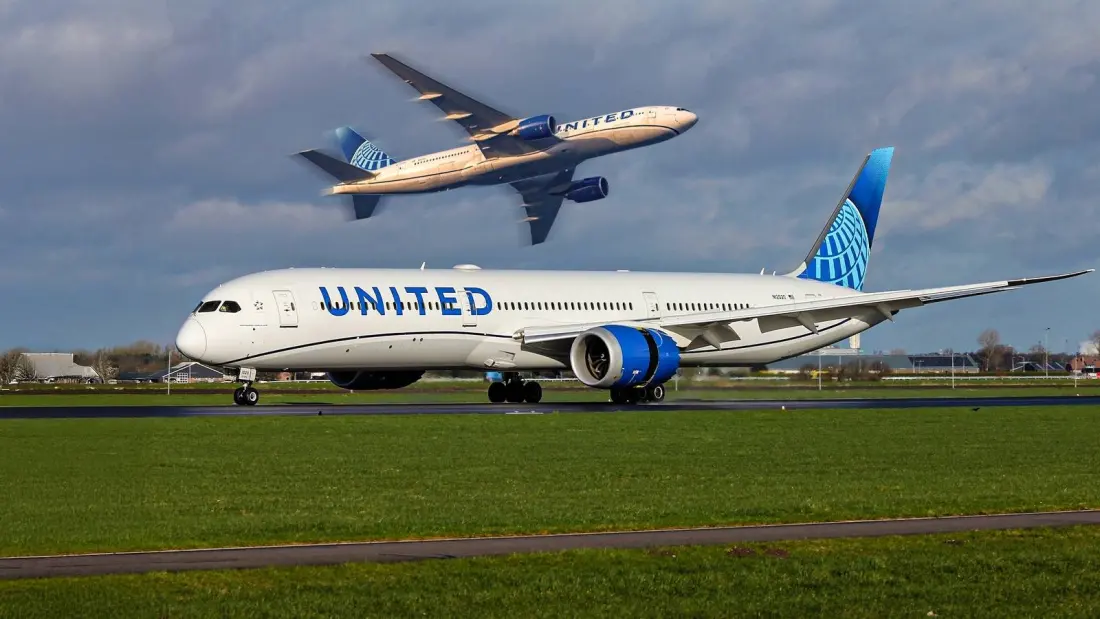
United's Newark–Athens flight keeps flying daily all year, but the plane at the gate changes with the seasons. Through the summer peak, the route ran Boeing's largest Dreamliner, the 787-10, with 318 seats. From 24 September to 23 October, a veteran Boeing 777-200ER takes over, and after that the smaller 767-400ER covers the winter lull. The timetable barely moves — the evening departure out of Newark and next-morning arrival in Athens stay effectively the same — but the cabin you're booked into changes underneath you.
Here's what that means for your ticket. The 777-200ER carries 276 seats overall: 50 Polaris business, 24 premium economy and 248 economy. Compared with the 787-10, that's 42 fewer seats in total — yet actually more premium ones, with six extra business seats and three extra premium economy. Both aircraft have 1-2-1 business suites, while premium economy goes from 2-3-2 on the Dreamliner to 2-4-2 on the 777. The winter 767-400ER is a step down again at 231 seats, with 34 in business.
Why the shuffle? Athens is a heavily seasonal leisure market, and demand that supported ten weekly summer flights drops to seven from late September. United would rather match a smaller, already-paid-for jet to softer demand than burn a fuel-efficient new Dreamliner on half-empty cabins. The 787-10s don't sit idle: they move to boost capacity on routes like Chicago–Paris and Chicago–Milan, plus a brief stint on Los Angeles–London.
It's a competitive route, too. Emirates flies a fifth-freedom service from Newark to Athens with its own 777s, while Delta and Norse both serve Athens from New York JFK. For travellers, that means decent fare competition even in the shoulder season — and a front-cabin product on United's autumn rotation that's arguably roomier per premium passenger than the summer version.
Worth noting for fleet watchers: this is the twilight era for United's 767-400ERs, which average 25 years old and are slated for retirement between 2027 and 2030, with 787s and new A321XLRs gradually taking over. Greece sits beyond what United considers practical A321XLR range, so widebodies should keep flying to Athens for the foreseeable future.