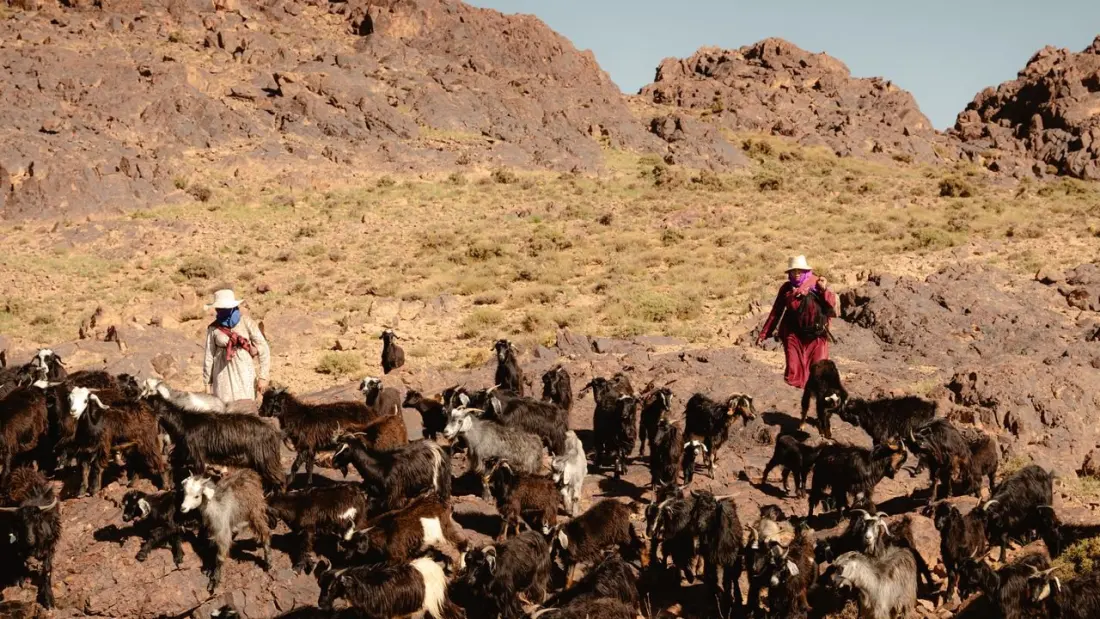
Twice a year, a handful of Berber families in southeast Morocco do what their ancestors have done for millennia: herd goats roughly 180 miles between summer pastures in the High Atlas and winter grazing on Jebel Saghro, a stark massif of mesas and volcanic crags that locals call the Land of Thirst. This seasonal trek — transhumance — is one of the oldest migrations in Africa, and it is fading fast.
Writer for Condé Nast Traveler joined one such family, the Belâawanes — matriarch Telhou, husband Hmad and teenage daughter Saâdia — on the autumn leg of their journey with a caravan of around 200 goats, three donkeys, herding dogs and a support crew arranged by travel operator Black Tomato. The trip is part of the company's new 'Keepers' collection, which pairs travellers with people whose traditional knowledge is still practised and passed down, from a Daoist master in Chengdu to a tide-reading fisherman on Chile's Chiloé Island. The idea: in a world where any fact is a search away, human skill and connection are the real luxury, and travellers want to be students rather than spectators.
Days on the trail run five to seven-plus hours, crossing passes such as the 8,200-foot Tizi n' Tircht, with the nomads dictating the pace — the women move with the herd, pausing hourly to graze the goats, while the men lead the donkeys and pitch camp at traditional stone pens called azib, each family holding hereditary rights to its routes. Mornings bring baghrir pancakes with amlou; evenings mean communal couscous or harira eaten straight from a shared bowl in a goat-hair tent, plus flatbread-making lessons and henna by firelight. Camps are packed out with no trace left behind.
What makes this more than a spectacular hike is the context. Rising temperatures and drought have shrunk pastures, school attendance is now mandatory for children aged 6 to 16, and modern conveniences are pulling the young toward village life. Hmad's sub-tribe once saw 80 families make this migration; this year just six did. The guides and mule handlers, many of them relatives who gave up nomadism themselves, are the bridge between visitors and a way of life that may not outlast another generation.
For travellers, this is a rare chance to put purpose behind a trek — learning to herd with a slingshot, distinguishing individual goats, communicating across languages with laughter and a few shared phrases. You'll earn blisters, bucket showers and a genuinely memorable dinner, but also a firsthand view of a culture surviving on its own terms.