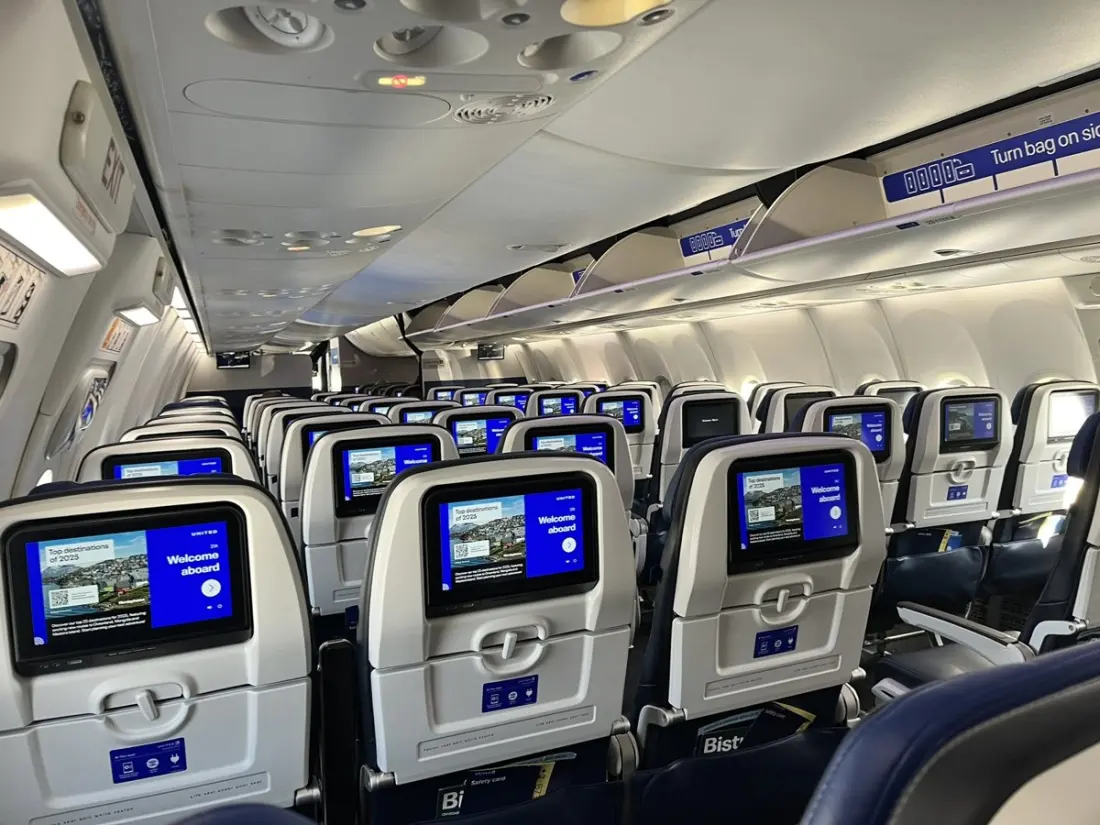
United Airlines is about to make slow inflight internet a thing of the past on most of its fleet. An internal plan leaked by aviation watcher JonNYC shows the airline now expects Starlink Wi-Fi on more than 1,000 mainline aircraft by May 2027, with installations running at over 20 planes a week across 17 maintenance stations spanning Houston, Orlando and San Antonio to Hong Kong, Singapore, San Salvador and Rio de Janeiro.
That's a serious acceleration. United first promised free Starlink back in September 2024, and has repeatedly pulled its timeline forward: 300 regional jets were done by February 2026, a Starlink-equipped 777-200 entered transatlantic service by June, and the previous target of roughly 1,000 aircraft by end-2026 counted regional jets. The new figure is mainline aircraft alone — even more aggressive than the dual-class-fleet-by-2027 goal.
The contrast with Delta is stark. Delta has signed with Amazon's satellite service, which hasn't launched a consumer aviation product yet, and its 2028 start date only covers about 500 planes — half its mainline fleet — assuming Amazon delivers. Delta is also hedging with Hughes Fusion and Hughes equipment on new A350-1000s. United is openly exploiting the gap: its "Switch To Better Wi-Fi" offer gives Delta and American elites 90 days of matched status (up to Premier 1K) if they apply by October 15, with a spending challenge to keep it into 2028. American starts its own Starlink installs in early 2027, Alaska is targeting 2027, Southwest has over 300 aircraft due by end-2026, and even Frontier joins in 2027.
Why should travellers care? Because the performance gap is real. In Ookla's early-2025 inflight tests, Starlink delivered median download speeds around 152 Mbps with 44ms latency, versus about 50 Mbps and hundreds of milliseconds of lag for Viasat. Low latency means video calls, cloud apps and browsing that actually work at altitude. Surveys back up the switching behaviour: a 2016 Honeywell poll found a fifth of flyers had abandoned a preferred airline for better Wi-Fi, and Viasat's 2024 survey of 11,000+ passengers found three-quarters more likely to pick a long-haul carrier with good connectivity. United says satisfaction scores on equipped planes have nearly doubled.
The practical takeaway: within about a year, if you need to work in the air, choosing United becomes a safe bet rather than a gamble on whether your particular aircraft has decent internet. Free, fast connectivity across the fleet also shifts the value equation on fares — a cheap ticket that costs you four productive hours isn't cheap. Watch this space if you routinely book Delta transcons or long-haul; its competitive answer may not arrive until 2028.