The longest flight flown by a US airline in 2026 isn't the longest on paper. That title belongs to United Airlines' Houston-Sydney service, which covers 8,596 miles (13,834 km) across the Pacific on a Boeing 787-9. Launched in 2018, the seasonal route gives travellers from Texas and much of the central and eastern US a direct link to Australia with no West Coast stop. The westbound leg clocks in around 17 hours thanks to headwinds; the return is closer to 15 hours 30 minutes. United schedules roughly 154 flights and 39,578 seats each way per year.
Here's the twist: by scheduled time, United's San Francisco-Singapore route actually runs longer - up to 17 hours 40 minutes against Houston-Sydney's 17 hours 35 minutes - despite covering 150 fewer miles. Block time, which runs from gate departure to gate arrival, depends on winds, routing and schedule padding, so distance and duration rankings don't always agree.
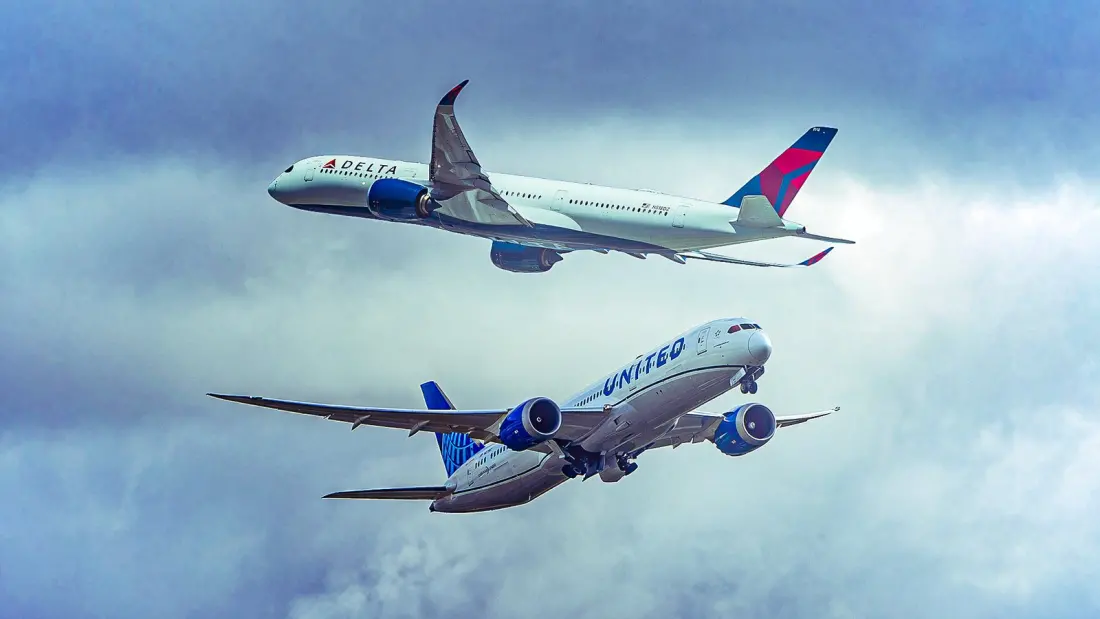
United isn't alone in this league. Delta's Atlanta-Johannesburg service covers 8,433 miles and can take up to 17 hours 5 minutes, while American's Dallas/Fort Worth-Brisbane route - its longest ever, launched in October 2024 - spans 8,299 miles with block times up to 17 hours 15 minutes. All four sit within about 300 miles and 35 minutes of each other.
What makes these flights commercially viable is cabin design. American uses a premium-heavy 787-9P with 244 seats including 51 business suites, versus 285 seats in the standard version. Delta trims its A350-900 to 275 seats from the usual 306 - partly because Johannesburg's high altitude demands payload discipline. Fewer seats at higher fares help balance the fuel, passenger and cargo weight equation over sectors this long.
There's still room to grow. Singapore Airlines' Singapore-New York route stretches about 9,537 miles using the specialised A350-900ULR, roughly 940 miles beyond United's record. US carriers haven't matched that, partly because they fly standard 787-9s and A350-900s rather than dedicated ultra-long-range variants. Qantas' Project Sunrise - A350-1000s connecting Australia directly with London and New York - could reset expectations for everyone. For now, the next shift in the US ranking will likely come from a fleet decision or a new route announcement, not from the current schedule.
For travellers, the takeaway is simple: if you're booking one of these monster nonstops, seat configuration matters more than usual. The premium-heavy layouts mean fewer economy seats and longer competition for them, while the business cabins on routes like Dallas-Brisbane are among the most generous afloat or airborne.