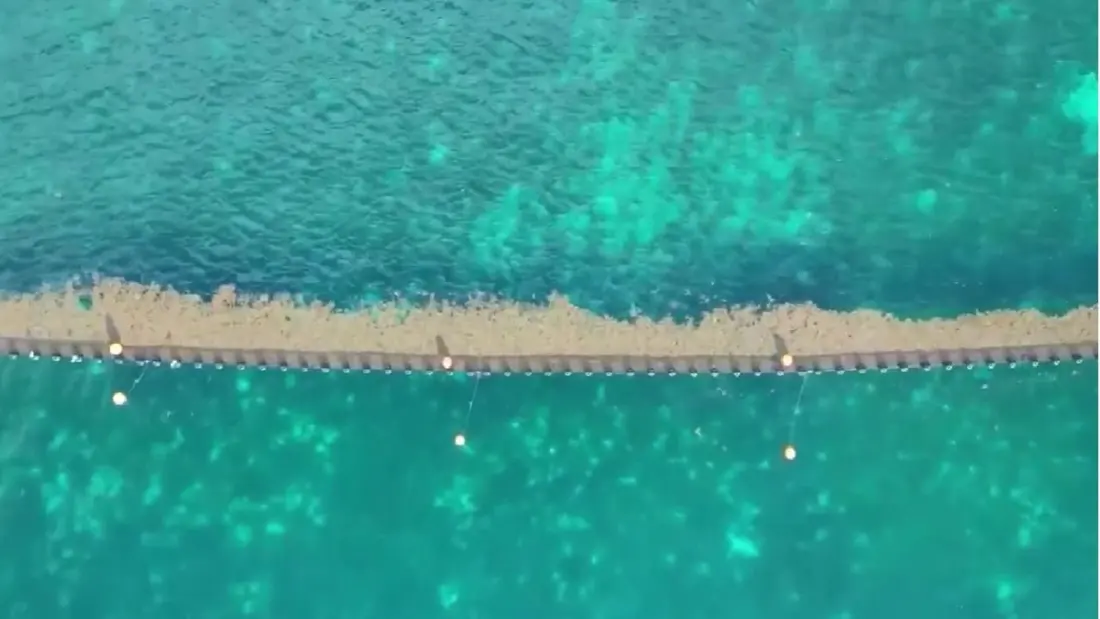
Quintana Roo officials sat down this week — earlier than usual — to plan for a sargassum season that scientists expect to be the biggest yet. Projections put roughly 80 million tons of the seaweed floating in the Atlantic for 2027, up sharply from about 38 million tons in 2025 and 60 million this year.
The numbers on the ground are already climbing. Cancun alone has hauled more than 32,000 tons off its beaches so far this season, nearly double last year's haul, and the state of Quintana Roo has collected over 133,000 tons in total during 2026.
Governor Mara Lezama led the strategy meeting, stressing that the problem spans the whole Caribbean — from Mexico to the United States and beyond — rather than being a Mexican issue alone. She credited President Claudia Sheinbaum with making sargassum a federal priority; the president recently toured the Sargassum Monitoring Center in Cancun.
That monitoring hub is the most interesting piece of the effort for travellers hoping for clean sand. Under an agreement with the European Space Agency, it pulls data from 12 satellites, mostly from the Sentinel family, and uses a specialised algorithm combining ocean currents, winds and satellite imagery at resolutions down to 10 metres. The result: sargassum can be tracked from waters off West Africa all the way to the Mexican Caribbean, giving authorities days of lead time to deploy barriers and collection crews before it washes ashore.
There are longer-term ideas in play too. Researchers at the Yucatán Scientific Research Centre (CICY) are testing whether sargassum can be turned into feed for certain species — one of several efforts to find uses for a seaweed that otherwise piles up as waste. Cancun also recently hosted more than 350 delegates from over 45 countries at the 4th EU-Caribbean Global Gateway Conference on Sargassum, aimed at sharing detection technology and disposal solutions across the region.
Why is it getting worse? NOAA and the UN Environment Programme point to nutrient runoff from agricultural fertilisers and climate change, with warmer sea temperatures speeding up growth rates. Those drivers aren't going away soon, which is why officials started planning months ahead.
If you're eyeing Cancun, Tulum or Playa del Carmen, this matters directly to your beach time. Sargassum season generally runs from spring into autumn, peaking in summer, while the winter months typically see far less of it. The monitoring system means hotels and local crews increasingly get warning before a big landfall, so cleanup is faster than it used to be — but 80 million tons at sea is a serious test. If a pristine beach is the point of your trip, consider travelling between December and April, pick beaches on the exposed windward coast with a good cleanup record, and check live sargassum maps before booking.
Story via Riviera Maya News.