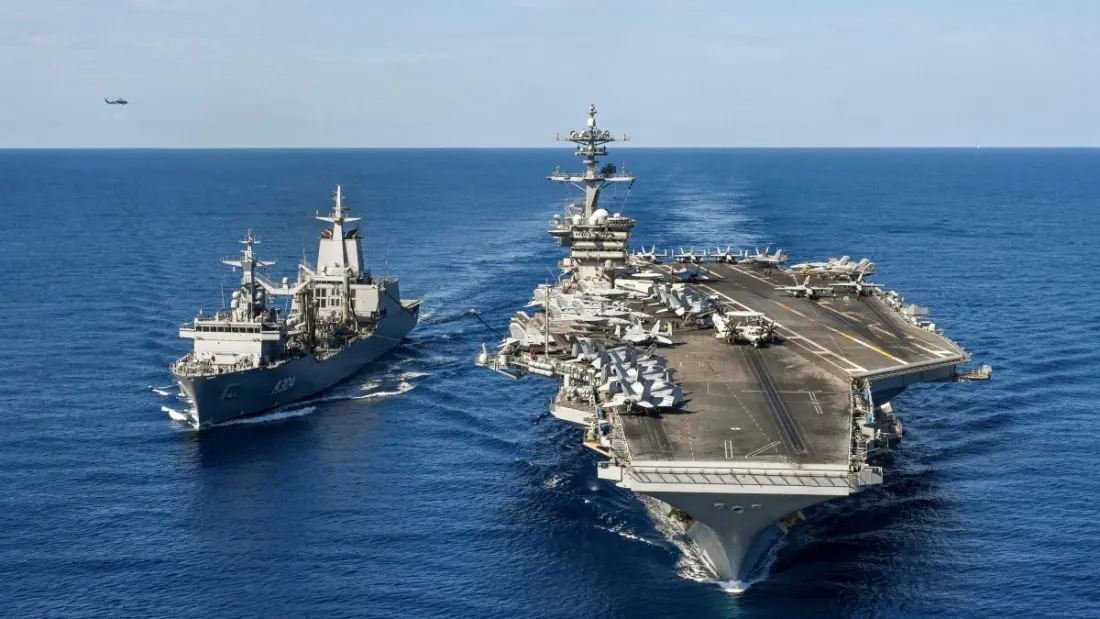
The US Navy now has three aircraft carrier groups in the Middle East. Central Command confirmed on Monday that the USS Theodore Roosevelt is operating in the region, arriving a day earlier according to reporting by Axios, which cited an unnamed American official. The Nimitz-class carrier sailed from Singapore earlier this month, passed through the Strait of Malacca, and is now part of a deployment the Pentagon describes as scheduled rather than a reaction to any single event.
The Roosevelt, a 40-year-old warship built by Northrop Grumman in Virginia, serves as the flagship of Carrier Strike Group 9 and began this deployment on 27 September. It joins the USS George H.W. Bush and USS George Washington, which were already in the region alongside more than a dozen US destroyers.
The buildup comes at a tense moment. A war involving Iran began with coordinated US and Israeli strikes in late February, and diplomacy has since stalled. President Donald Trump recently removed Vice President JD Vance from the peace talks and said publicly that Washington no longer needs an agreement with Tehran. He plans to raise the conflict at a trilateral meeting with China's Xi Jinping and Russia's Vladimir Putin this week.
Tehran, for its part, has kept the Strait of Hormuz closed since the war began — a waterway that carries a large share of the world's oil — but says it could reopen it within two days if the US releases frozen Iranian assets, lifts sanctions and ends its naval blockade of Iranian ports. American officials have pushed back on Israeli media reports claiming new strikes on Iran were being prepared, calling the suggestions pure speculation.
For anyone with Middle East travel plans, the practical takeaway is straightforward: the region's main sea corridor remains closed, naval forces are heavily concentrated, and the situation is changing week to week. Airlines and cruise operators have already adjusted routes around the Gulf, and travel advisories for several countries in the area are at their highest levels. Anyone booked on flights or tours touching the Gulf, the Red Sea or overflight routes through regional airspace should check their operator's latest guidance before departure and keep an eye on Foreign Office or State Department updates.
This is a developing geopolitical story rather than a holiday pick, and we'll flag it again if conditions change enough to affect travel. — Daily Sabah Travel