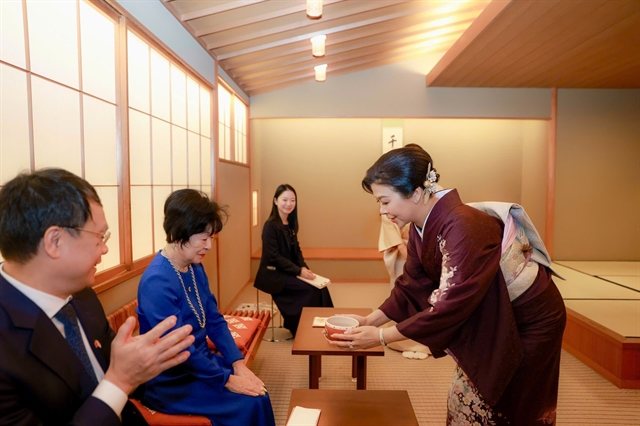
A bowl of whisked green tea turned into a quiet piece of diplomacy in Tokyo this week. Madame Ngô Phương Ly, wife of Vietnam's State President Tô Lâm, took part in a traditional Japanese tea ceremony at the State Guest House Akasaka on the evening of Monday, 9 November, during her husband's official visit to Japan.
The First Lady arrived dressed in a kimono and was walked through the ceremony's background by the tea master presiding over the gathering — an art form the host traced back roughly 450 years to Sen no Rikyū, the most revered figure in Japanese tea history. A detail worth savouring: the utensils chosen for the ceremony were deliberately picked to echo 16th-century Vietnamese pottery, a nod to the centuries-old trade and cultural exchange between the two countries.
After the introduction came the hands-on part. Madame Ly tasted traditional sweets and tea, then joined the artisan at the preparation area to whisk the powdered matcha herself. She then offered the very first bowl to Akiko Santō, former President of Japan's House of Councillors and the oldest guest in the room. Santō, reportedly charmed by her kimono, appreciated the gesture — it fit neatly with both cultures at once, reflecting the reverence central to Japanese tea ritual and the Vietnamese saying kính lão đắc thọ, roughly "respect for elders brings longevity."
The contrast between the two tea cultures made the moment land. In Japan, tea has been refined into a formal art governed by ritual and stillness; in Vietnam it remains an everyday gesture, typically the first thing offered when a guest crosses your doorstep. Calligraphy in the tea room spelled out Thiên lý đồng phong — "sharing the same wind across a thousand miles" — a nod to ties that stretch back to when Vietnamese ceramics first travelled to Japan.
For tea-minded travellers, there's a practical footnote here too. Vietnam is now among the world's five largest tea-producing countries, and its leaves are increasingly used to make matcha to Japanese standards — companies such as Morinaga have explored joint production aimed at the Vietnamese market. So the flavours you meet in a Kyoto tea house and the tea you're served in a Hanoi home are starting to share roots, literally.
Why does a state-visit tea ceremony matter to anyone planning a trip? Because it spotlights two experiences that are genuinely accessible to visitors: booking a chado (tea ceremony) session in Tokyo or Kyoto, where you can be guided through whisking matcha just as the First Lady was, and exploring Vietnam's tea country — from the plantations of Thái Nguyên in the north to the ancient tea trees of the northwest highlands. Both offer an intimate way into two cultures that, as this small gathering at Akasaka showed, have been trading ideas and objects across the sea for half a millennium.
Reported by Vietnam News Life.