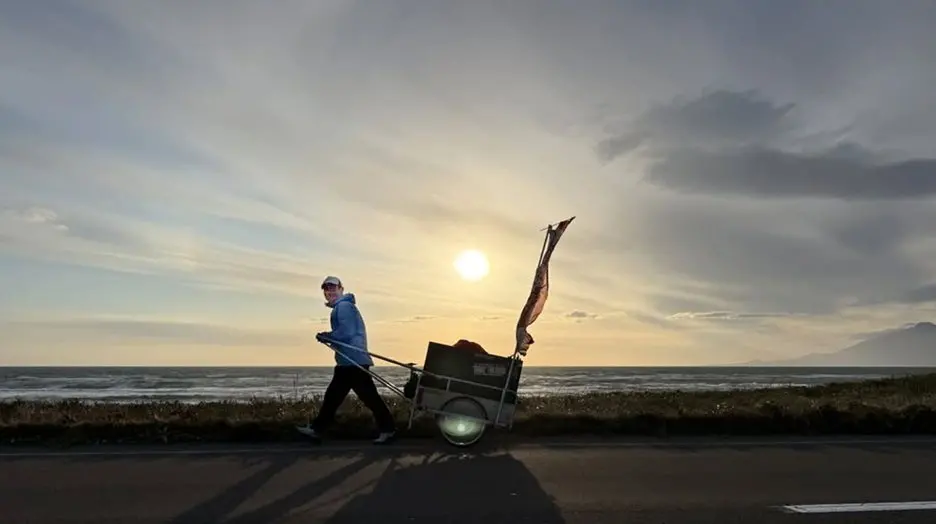
A 49-year-old Japanese publisher is currently walking the country end to end — 3,345km from Cape Sōya at the northern tip of Hokkaido to Cape Hedo on Okinawa — in the depths of winter, pulling a handcart weighing roughly 100kg.
Katsunari Tanaka set off on October 7 and plans to finish within about 100 walking days spread over five months, averaging around 35km a day with rest days built in. He has a support vehicle on standby for emergencies, and teammates occasionally join him for a day at a time. He sums up the race against the seasons simply: chasing winter down the map.
The early legs have not been gentle. Freezing temperatures, rain and fierce headwinds slowed him through Hokkaido, and when he crossed the mountain pass between Yoichi and Iwanai in late October, blowing gravel gave way to falling snow. He sheltered with his team until conditions eased, then pressed on to reach Hakodate Harbor on November 3 — 621km of Hokkaido covered. From there he ferried across the Tsugaru Strait to Aomori, and his route now runs down the Sanriku coast to Sendai, along the Pacific through Fukushima to Tokyo, then via the historic Tokaido corridor to Osaka and west to Kyushu. A final ferry hop takes him to Okinawa for the finish at Cape Hedo.
What makes this interesting is that Tanaka rejects the adventurer label altogether. He calls himself a merchant. A decade ago he spent three years hauling books by handcart to every one of Japan's 47 prefectures, selling 13,477 copies face to face between 2013 and 2016 — an experience he credits with shaping his whole approach to business and human connection. This walk is a show of support for his mentor, Arthur Hollands, a Japanese evangelist famous for long walks carrying a large wooden cross. Along the way Tanaka will give lectures at 11 stops, and he has openly invited anyone curious to join him for stretches of the route.
Why should a traveller care? Because Tanaka is effectively tracing one of the great long-distance itineraries — a full north-to-south line through Hokkaido's wild passes, the rugged Sanriku coast, central Japan's classic Tokaido and the subtropical Okinawan islands. His publicly documented progress, ferries included, doubles as a rare practical blueprint for anyone dreaming of an ambitious Japan trip beyond the usual Tokyo–Kyoto loop. And since he welcomes walking companions, parts of his route could be walked alongside him rather than just read about.