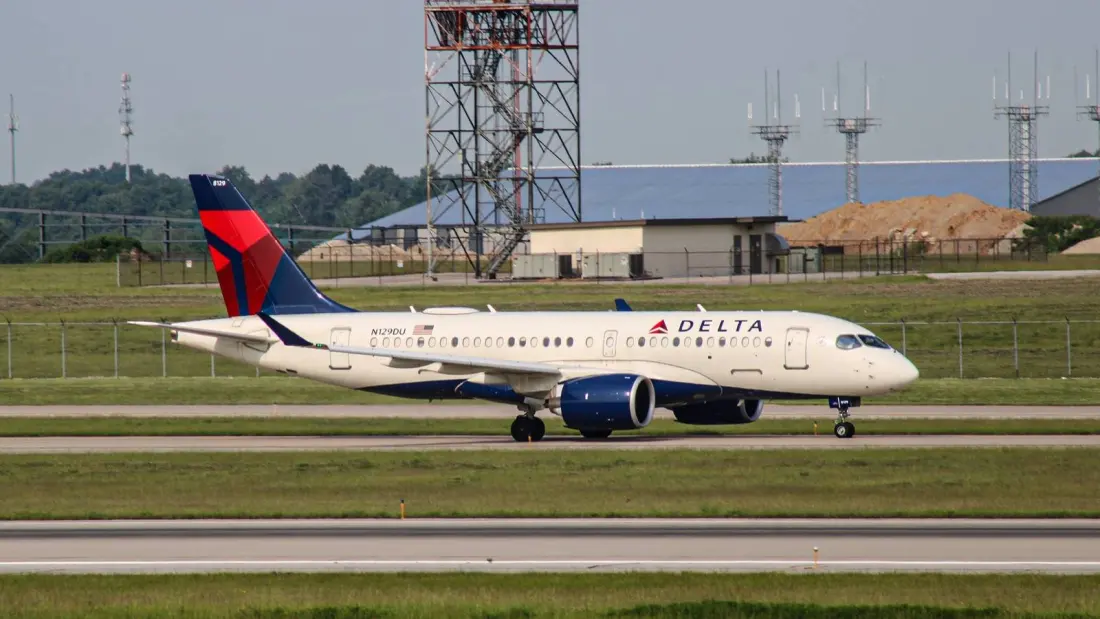
Delta is the only big US airline with a genuinely small mainline jet in service. Its Airbus A220-100s seat 109 passengers — smaller than anything at American or United — while the A220-300s seat 130, still below the smallest new planes its rivals have ordered. That gap in the middle of Delta's fleet is doing more work than you might think.
The numbers tell the story. Delta flies 45 A220-100s and 47 A220-300s, with another 53 of the larger variant still on order. Its smallest other mainline jets, the 110-seat Boeing 717s and 132-seat A319s, bracket the A220 family, while the 160-seat 737-800s sit about 50 seats above the A220-300. Regional flying under the Delta Connection brand is capped at 76 seats, so the A220s slot neatly between the two tiers.
The backstory is famous in aviation circles. Bombardier sold Delta 75 of what were then CS100s at roughly $20 million each — well below list price — prompting a Boeing dumping petition and a 300% tariff. That fight pushed Bombardier into Airbus's arms, the jet was rebranded the A220, and Delta is now the type's largest customer.
So why does the aircraft matter for travellers? It's the route map. Delta bases its A220s in New York (LaGuardia and JFK), Seattle, Salt Lake City and Minneapolis, and uses them mostly on longer, thinner routes flown once or a few times a day: Seattle to Washington National or Fairbanks, Salt Lake City to Pittsburgh, JFK to Dallas/Fort Worth. A 737-800 would be too big to fill on those routes; an A319 or regional jet burns far more fuel for the size. The A220 reportedly burns over 20% less fuel per trip than a 737-800, letting Delta keep nonstop service on routes that would otherwise be marginal — or not exist at all.
There were also financial and contractual reasons. Buying the type raised Delta's pilot scope-clause cap on 76-seat regional jets to 223 aircraft, unlocking more lucrative Delta Connection flying. And the bargain price turned a good plane into a steal.
American and United see it differently. American's scope clause doesn't reward adding a small jet, United is capped at 153 76-seaters but is focused on upgauging to A321neos and bigger MAX variants, and both carriers' smallest new orders are 160-172-seat 737 MAX 8s. Modern price segmentation with basic economy fares also makes it easier to fill large planes, which erodes the case for smaller ones.
The trade-off for Delta: fixed costs like pilots and airport facilities don't shrink with the aircraft, so the A220 has 30 to 51 fewer seats to spread them over than a 737. But on the long, low-frequency routes where it's deployed, the maths works — and passengers on routes like Salt Lake City to Pittsburgh get nonstops that might otherwise disappear.
If you're flying domestically within the US on Delta, chances are decent you'll end up on an A220 — a newer, quieter, more comfortable cabin than the older narrowbodies it competes with.
Story via Simple Flying.