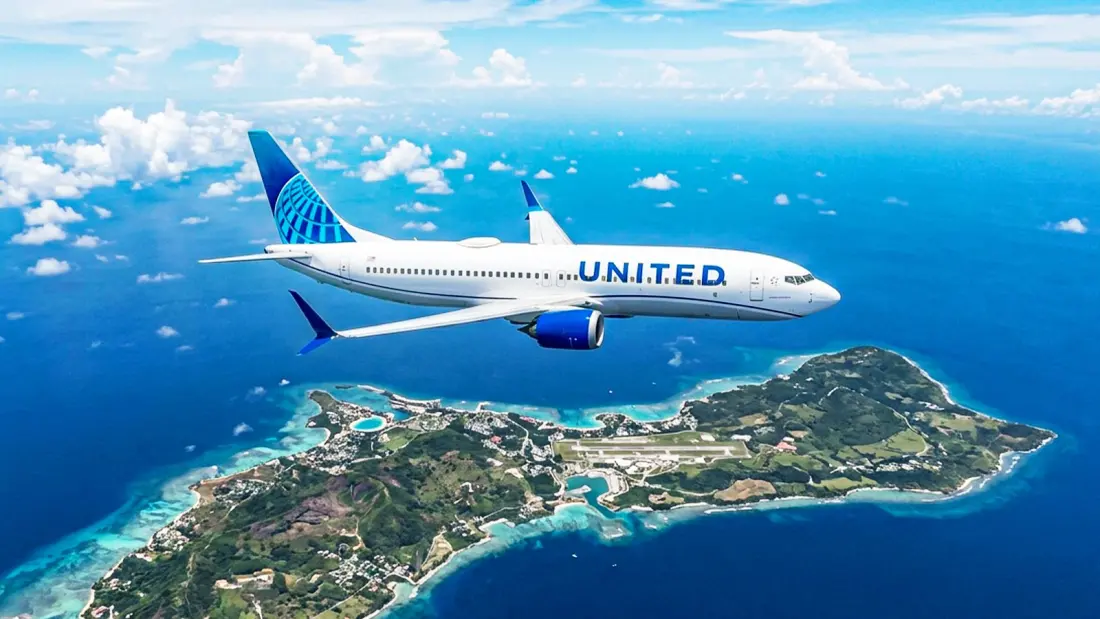
United Airlines flies to every corner of the American mainland from seven hubs, from Newark to Los Angeles. But it's the eighth hub, on a Pacific island closer to Manila than to Hawaii, that makes United unique: it's the only US carrier still operating a genuine overseas hub, at Guam's Antonio B. Won Pat International Airport (GUM).
Today the operation runs up to 12 daily flights to 15 destinations across five countries, serving Taipei, Manila, Palau's Airai, Saipan, and four Japanese cities, plus a handful of specks in Micronesia most travellers couldn't place on a map. Most routes use the 737 MAX 8, which replaced the older 737-800s between March and October 2026, complete with English-Japanese signage (not Spanish) and a collapsible front economy row for medical evacuation flights. The one long-haul route, Guam to San Francisco via Honolulu, flies a Boeing 777-300ER, kept on the run largely because of strong cargo demand.
The hub's roots go back to 1968, when Continental Airlines helped launch Air Micronesia — 'Air Mike' — flying Boeing 727s between islands that had almost no other air links. It became Continental Micronesia, Guam's largest private-sector employer, and was folded fully into United after the 2010 Continental merger. Its most famous route survives: the Island Hopper, a marathon Guam-to-Honolulu service hopping through Chuuk, Pohnpei, Kosrae, Kwajalein and Majuro. Two first-class seats are blocked off on that flight as pilot crew rest.
Why does United keep it when rivals walked away? Delta and United both once ran hubs at Tokyo Narita, but cheaper long-range jets like the 787 let them fly nonstop from the US to Asia instead, while joint ventures with ANA and Korean Air cover the regional routes. Guam is different — it serves a local market where United faces almost no competition, plus a steady stream of military and government traffic it effectively monopolises. Even during recent softness in Japanese demand, United found a clever fix: sending its Guam-based 737s north to Narita for new fifth-freedom routes to Cebu, Kaohsiung and even Ulaanbaatar, Mongolia — destinations ANA doesn't fly, generating plenty of buzz in the process.
For travellers, this is practically the only way into much of Micronesia. If you've ever dreamed of Palau's rock islands or diving Chuuk Lagoon's wreck-filled lagoon, United's network is the realistic route in, with Japan as the busiest feed. It's niche flying, but it connects places that would otherwise be a far bigger expedition.