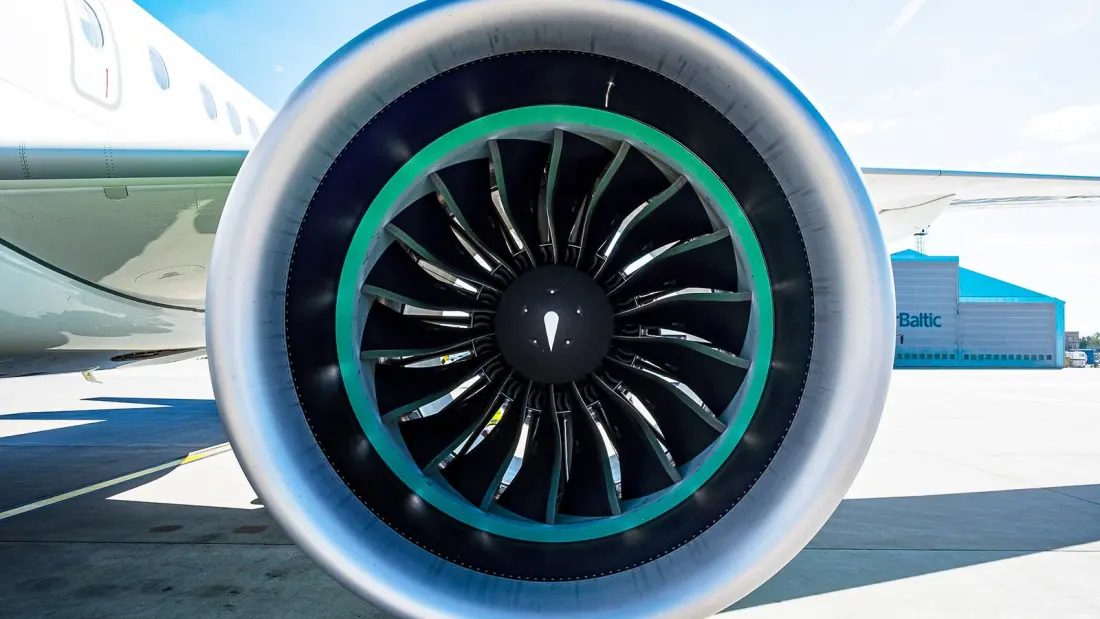
Anyone who has boarded an Airbus A320neo or an A220 has probably noticed it: a bright teal-green ring lining the engine intake, just ahead of the fan blades. The colour shows up on both the PW1100G and PW1500G variants of Pratt & Whitney's Geared Turbofan, and it has fuelled years of debate among aviation fans. The real explanations turn out to be a mix of acoustics, materials science and plain old practicality.
The wide green band is the engine's acoustic liner — a perforated skin bonded over a honeycomb core. Sound waves pass through the tiny holes into honeycomb cells that act like small resonant chambers, absorbing fan noise and converting part of it into heat. Because the GTF's gearbox lets the fan spin slower than a conventional engine's, more of its noise sits at lower frequencies, which are harder to muffle and need deeper cavities. That's why the liner takes up such a generous stretch of the inlet — a big part of why the A320neo and A220 are noticeably quieter than the aircraft they replaced.
The colour itself isn't paint. The teal shade is generally attributed to the resin and epoxy matrix of the composite material, and engineers have good reason not to coat over it: a thick layer of paint would block the microscopic perforations and ruin the panel's noise-absorbing performance. Just behind the liner sits a second, slightly lighter blue-green band — the abradable rub strip, which keeps the gap between fan blade tips and the case as tight as possible. It's mixed as a two-part epoxy, and the turquoise shade doubles as a quality check: if the colour looks streaky or uneven, the two components weren't blended properly.
There's also a very human reason for the bright hue. Fan cases sit in dark, shadowed cavities, and technicians performing quick walk-around checks between flights need to spot problems fast. Against green, foreign object debris, fluid stains and unusual wear patterns stand out clearly — green sits near the middle of the visible spectrum where our eyes are most sensitive, and it contrasts sharply with the reds, browns and oranges of oil and corrosion. Green primer has a long history in aerospace too, dating back to zinc chromate corrosion protection used on airframes for decades.
Why should a traveller care? If you've flown on an A320neo or A220 — and odds are you have, or soon will, with budget carriers and network airlines alike — that green ring is part of why your flight was quieter and burned less fuel. It's a small detail that explains a lot about how modern engines are engineered, inspected and maintained, and it'll stay a familiar sight for decades as the updated GTF Advantage rolls out. Next time you're walking down a jet bridge, take a second to look.