World Rhino Day lands on 22 September each year, and with roughly 26,700 rhinos left on Earth, it's a good moment to look past the usual safari snapshot. South Africa's Getaway Magazine has pulled together the key things worth knowing, and several of them genuinely surprise.
First, the basics: five rhino species survive today. Africa has the black and white rhino; Asia has the greater one-horned, Sumatran and Javan rhinos. Their fortunes differ wildly. Black, Javan and Sumatran rhinos are all Critically Endangered, the greater one-horned is Vulnerable, and the white rhino sits at Near Threatened. South Africa holds the majority of the world's southern white rhinos, which is why rhino conservation is such a live issue here.
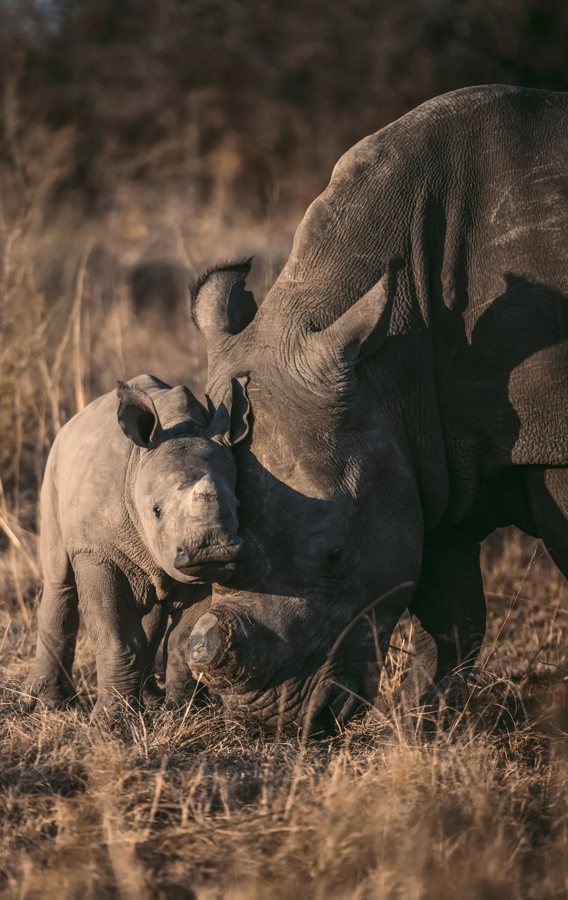
Those names? Misleading. Both African species are grey, and the reliable giveaway is the mouth. Black rhinos have a hooked upper lip for plucking leaves off bushes; white rhinos have a wide, square lip built for grazing grass. On safari, that's how guides tell them apart at a glance.
The horn is stranger than it looks: it's mostly keratin, the same protein in your hair and fingernails, and it grows throughout the animal's life. Not every species even has two — the greater one-horned and Javan rhinos carry just one, and the Sumatran rhino, smallest of the five, is the only Asian species with a pair.
The numbers tell a mixed story. The northern white rhino is down to two females at Kenya's Ol Pejeta Conservancy, guarded around the clock since the last male, Sudan, died in 2018 — scientists are now relying on assisted reproduction. The Javan rhino clings on with around 50 animals, all in Indonesia's Ujung Kulon National Park, while perhaps 34 to 47 Sumatran rhinos remain.
But there's genuine good news too. The greater one-horned rhino has climbed from 2,565 in 2007 to an estimated 4,075, thanks to decades of protection in India and Nepal. Black rhinos, which lost 98% of their population between 1960 and 1995, have rebounded to about 6,788 as of late 2024 — still Critically Endangered, but proof that sustained conservation works.
Practical takeaway for travellers: rhinos are faster than they look. Black rhinos can hit around 55km/h and turn sharply, which is exactly why guides insist you keep your distance. And beyond the spectacle, rhinos matter ecologically — as large herbivores they shape vegetation, open up habitat for other species and spread seeds through their dung.
For anyone planning an African safari, this is the context that turns a rhino sighting from a checkbox into something memorable. You may be looking at one of fewer than 7,000 of its kind — or, in the case of a northern white rhino in Kenya, one of two.