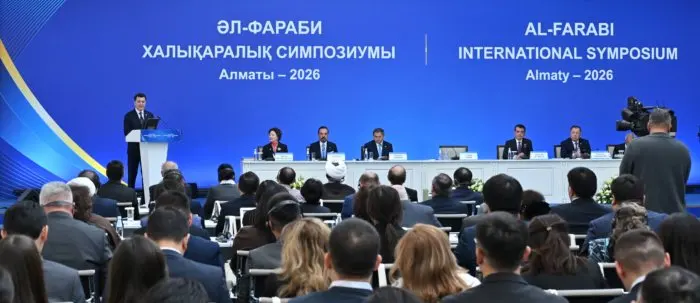
Kazakhstan is putting its intellectual history on a permanent schedule. At a symposium in Almaty on November 6, Vice President Erlan Karin announced that international gatherings celebrating the medieval philosopher Abu Nasr Al-Farabi and the theologian-poet Khoja Ahmed Yasawi will now be held every two years, alternating between Almaty and Turkistan. Each city gets its turn every four years.
The idea came from President Kassym-Jomart Tokayev, who framed the thinkers' legacy as anything but dusty. Al-Farabi (870-950), whose work on ethics, logic and the ideal society earned him the title 'Second Teacher' after Aristotle, taught in the Islamic world's golden age of science. Tokayev's message to the opening ceremony stressed that his ideas on the virtuous society remain relevant, and Karin argued they speak directly to a globalised, tech-driven era. The current symposium, hosted at Al-Farabi Kazakh National University, drew more than 150 scholars, researchers and delegates from international organisations.
There's a diplomatic layer too. On the sidelines, Karin met Salim AlMalik, head of the Islamic World Educational, Scientific and Cultural Organization (ICESCO), to line up joint cultural programming. The practical takeaway for travellers: ICESCO has named Turkistan the Cultural Capital of the Islamic World for 2027, and Kazakhstan is pushing to add ten new sites to ICESCO's Islamic World Heritage List. Joint events in Turkistan are already in the works, alongside the country's wider interfaith agenda, including the Congress of Leaders of World and Traditional Religions, whose ninth congress lands in 2028.
Why should a traveller care? Because this is institutional momentum behind destinations that are still refreshingly under-visited. Turkistan's Mausoleum of Khoja Ahmed Yasawi is a UNESCO World Heritage site and one of Central Asia's finest Timurid monuments, yet the city sees a fraction of the foot traffic Samarkand does. Almaty, meanwhile, pairs a leafy, mountain-backed grid of cafés and museums with easy access to the Trans-Ili Alatau. With the 2027 cultural capital title and a rolling calendar of academic and cultural events, both cities are about to get a wave of investment, restored sites, exhibitions and better visitor infrastructure. Go before the crowds catch on, or plan around 2027 when Turkistan will be at its liveliest.