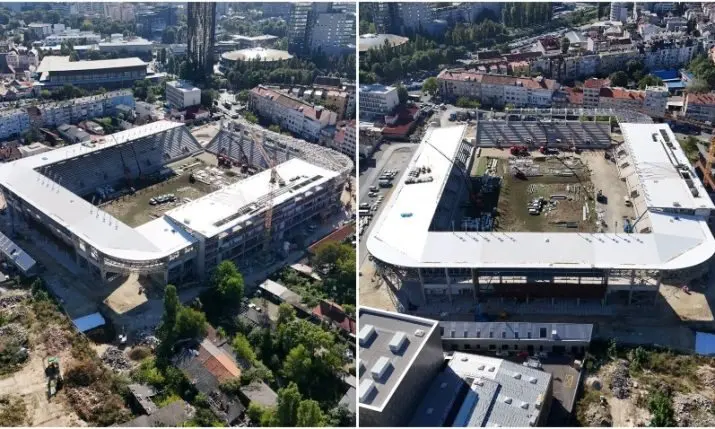
Zagreb's Trešnjevka district is getting a brand-new football arena, and it's starting to look the part. The rebuilt Kranjčevićeva Stadium has entered a striking phase of construction: the third corner arch of the roof structure is now in place, giving the venue its distinctive silhouette for the first time.
Work is moving on all four sides of the site. On the north and east stands, supports are going in ahead of seat installation. The west stand is getting its façade and building services, with roof sections being enclosed. The south stand is where you'll find the scoreboard taking shape alongside roof and installation work. Outside the bowl itself, crews are laying underground utilities and prepping new roads and asphalt around the stadium.
When finished, the arena will hold 11,163 covered seats around a full-size 105 by 68 metre pitch, built to UEFA Category 4 — the top tier of UEFA's stadium classifications — making it eligible for high-level European club football. The spec includes a heated hybrid grass surface, modern player and media facilities, accessibility features and upgraded security and multimedia systems. The wider scheme adds internal roads, pedestrian zones, parking, a public square of roughly 6,300 square metres, and (per the original plans) over 400 parking spaces plus a 1 MW solar plant.
The schedule has shifted once. An amendment to the contract between the City of Zagreb and contractor STRABAG, signed on 28 August, sets 1 December 2026 as the deadline for main construction works, with all contractual obligations due by 1 February 2027.
Why it matters to football fans: Kranjčevićeva is set to become the temporary home of both Dinamo Zagreb and Lokomotiva while Maksimir Stadium is demolished and rebuilt — and it can't happen until Maksimir is vacated. It's also the first completely new four-sided football stadium built in the Croatian capital in more than five decades, with construction starting in April 2025. For anyone planning a trip to watch Dinamo in the next few seasons, expect matchdays to move from Maksimir to Trešnjevka — a working-class neighbourhood west of the centre, well connected by tram and worth exploring for its markets and local cafés.
The takeaway for travellers: if your Zagreb trip in 2027 or beyond includes football, you could be among the first to see a match in the city's newest arena — and the wider Maksimir rebuild will reshape the city's matchday map for years after that.
Croatia Week