
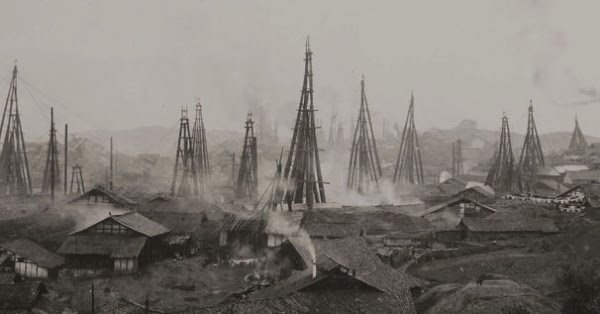
In 1835, drillers in Zigong, in China's Sichuan Province, finished the Shenhai Well — roughly 1,001 metres deep, the first well in the world known to have passed the one-kilometre mark. No steam engines, no steel cable, no electricity. Just iron, bamboo, rope, muscle and extraordinary patience.
Sichuan sits far from any coast, but beneath it lie enormous brine deposits. Communities were tapping them as early as the first millennium BCE, and by the Song Dynasty (960–1279 CE) Chinese well technology had no equal anywhere. The method was percussion drilling: a heavy iron bit, hanging from a bamboo pole and a seesaw-style wooden lever, was lifted about a metre and dropped again and again, pulverising the rock. Progress was brutally slow — a good day might advance four inches to a foot; some inches took days; some wells took years. Teams of specialised bits handled different jobs, from the 150–250 kg "Fish Tail" that opened the wellhead to the "Horseshoe" that drilled slowly but left a smooth, high-quality bore.
The payoff was depth — several hundred metres routinely, and by the 19th century over 1,000 metres — plus a bonus most industries would kill for: many deep wells released natural gas. Engineers captured it with pipelines built from hollow bamboo segments and burned it to boil brine into salt, one of the earliest industrial uses of natural gas on record. With derricks crowding the horizon and bamboo lines running for miles, Zigong looked like an oilfield decades before the petroleum age. It even helped launch one: images of these derricks reportedly inspired George Bissell, father of the American oil industry, to try drilling for oil in Pennsylvania.
Salt made Zigong rich. Starting a borehole cost around 3,000 pieces of silver, but Sichuan's difficult transport routes made local production worthwhile anyway, and the city supplied the province well into the 1930s. The old ways ended in 1946 when the first rotary-drilled modern well came in, and the wooden rigs slowly rotted away. One survives: the Shenhai Well still pumps and boils brine by hand today, its salt going into Sichuan-style pickles and canning. Zigong itself now runs on natural gas, coal and chemicals — and preserves its salt heritage in an excellent Salt Museum, complete with sculptures of the drilling crews at work.
For travellers, this is one of those stories that makes a Chinese itinerary click: a city where you can watch salt made with two-millennia-old technique, see the machinery that prefigured the global oil industry, and then roll on to Chengdu, a couple of hours away, for hotpot seasoned — fittingly — with pickle brine and salt.