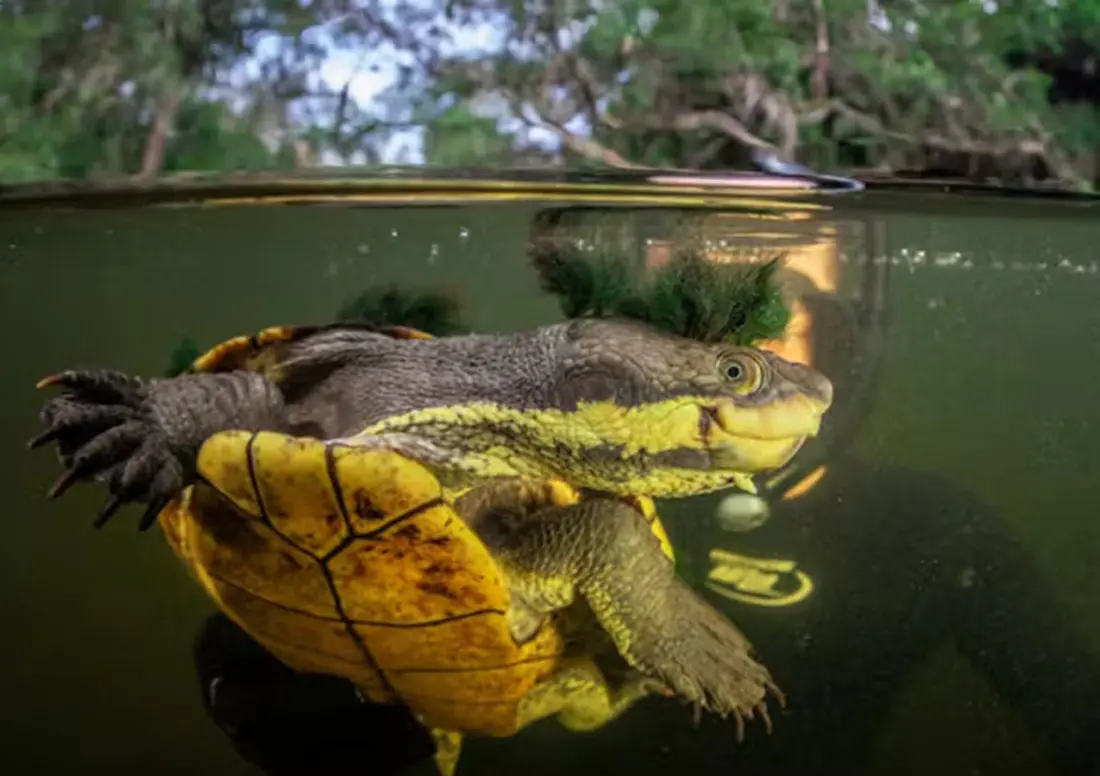
The Manning River helmeted turtle, known as Guraa in the Gathang language of the Birpai people, has been swimming through a small cluster of coastal rivers in northern New South Wales for around 55 million years. With a bold yellow stripe running from nose to tail, it's often called Australia's most beautiful freshwater turtle — and it exists nowhere else on the planet. It's also endangered, squeezed by habitat clearing, the illegal pet trade and feral predators.
Now researchers have flagged a stranger threat: another Australian turtle, transplanted into the wrong river. Macquarie River turtles, native to inland systems like the Murray, first turned up in the Manning River catchment in 2007, most likely released by people dumping unwanted pets. They've since spread across nine tributaries and are now competing with locals for food, potentially carrying disease, and — most worryingly — breeding with them. Hybridisation has already been documented in the nearby Bellinger and Kalang Rivers, where Macquarie turtles were introduced back in the 1990s, and it can effectively erase an endangered species by diluting it out of existence.
Tracking the invasion used to mean snorkelling rivers and setting traps — slow, expensive work. A research team from Charles Sturt University, the University of Canberra and the University of New England has developed a faster option: environmental DNA (eDNA) tests sensitive enough to pick up a single species from a bottle of river water. Using a portable filtering backpack, they sampled water at five sites across the Manning catchment in just three days. The results matched the traditional snorkel surveys run by ecologists from the Redleaf Group: Manning River turtles everywhere, no Macquarie invaders detected yet. That's good news, though the researchers caution more sampling is needed before anyone calls the catchment clear.
Why does this matter beyond the science? Because eDNA surveys are simple enough for anyone to run. The researchers see them as a citizen science tool that could plug into existing projects like 1 Million Turtles and TurtleSAT, where the public logs turtle sightings. For travellers heading to the NSW north coast, the story is a reminder of how fragile — and how local — these river systems are. The Bellinger and Manning rivers are scenic drives off the Waterfall Way and Pacific Highway, and keeping pet turtles out of waterways they don't belong in is a genuinely useful thing any visitor or resident can do. Australia is used to feral invaders from overseas; this case shows a native species can be just as damaging in the wrong river.
For now, the race is on to map where the Macquarie turtles spread next before they reach the last strongholds of two turtles found in only two river systems on Earth.