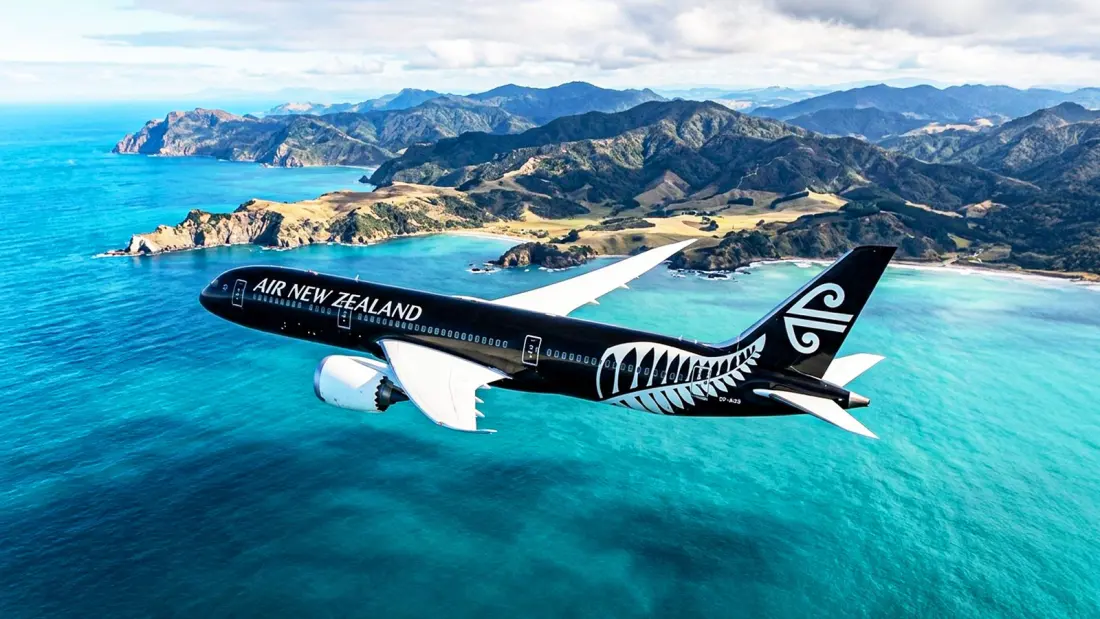
Flying from New Zealand means covering serious distances with modest passenger numbers, and Air New Zealand's 115-strong fleet is built around exactly that problem. The airline splits its work into four layers: domestic hops across New Zealand's two main islands, trans-Tasman services to Australia, thin routes across the Pacific Islands, and some of the longest non-stop flights on earth.
Domestically, turboprops do the heavy lifting. The carrier runs 31 ATR 72-600s and 23 Q300s (Dash 8-300s), making it the world's largest operator of the type — jets simply don't make economic sense on short, mountainous routes with light demand. Jet capacity goes to the busier trunk routes, where Jetstar provides competition on the Auckland–Wellington–Christchurch–Queenstown corridors under the Australia–New Zealand Single Aviation Market, which opened NZ's domestic market to qualifying Australian airlines in the late 1990s.
At the other end of the scale sit ten Boeing 777-300ERs and 14 Boeing 787-9 Dreamliners, including the aircraft that fly Auckland to New York. In between, a mix of 17 A320ceos and 20 newer A320neo/A321neos covers Australia and the Pacific Islands, with four more A321neos and ten more 787s on order.
Auckland is the South Pacific's key hub. From there the airline reaches Samoa, Tonga, Fiji, New Caledonia, French Polynesia, the Cook Islands, Niue and Hawaii. Some routes, like Fiji, run multiple times daily with rival carriers; others are extremely sparse. Niue, home to roughly 2,000 people, depends entirely on Air New Zealand's single weekly flight from Auckland — the island's only link to the outside world. Intriguingly, the airline doesn't serve everything close to home: the Chatham Islands (population around 620) are flown exclusively by independent Air Chathams under an interline deal, and Tokelau has no airport at all.
The historic ties explain the network. New Zealand administered Samoa, the Cook Islands, Niue and Tokelau during the 20th century, and today the Cook Islands and Niue sit in free association with New Zealand — their citizens are New Zealand residents in numbers that sometimes exceed the populations back home. That flow of people keeps routes viable where pure tourism demand wouldn't.
For travellers, the near-term change worth knowing is the cabin retrofit: all 787-9s are being refitted to a common standard by the end of 2026, introducing Business Premier Luxe suites, with an updated example already flying 219 passengers in four classes. The airline has also built a reputation for cabin innovation — the Skycouch, Skynest bunk beds and themed safety videos — and consistently ranks among the world's safest airlines on AirlineRatings.com. Christchurch and Wellington offer secondary international gateways, while Queenstown connects mainly to four Australian cities for the alpine adventure crowd.
Story based on reporting by Simple Flying.