Bhutan has a problem it can't ignore: its young people are leaving. Skilled graduates are heading overseas in search of salaries and prospects that the small Himalayan kingdom struggles to offer, and officials now describe the exodus as a warning sign rather than a temporary blip.
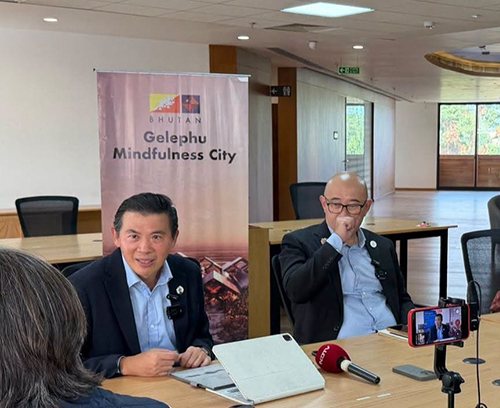
Dr. Lotay, Governor of the Gelephu Mindfulness City (GMC) project, sees the departures as a symptom of deeper economic issues — but not a broken bond. He points to the huge crowds of Bhutanese who turned out during the King and Queen's visit to Australia as proof that connection to home runs deep. His argument is that Bhutanese youth carry something distinctive wherever they go: they remain rooted in their culture and traditions.
That's the tension at the heart of GMC, the ambitious new city planned at Gelephu in southern Bhutan near the Indian border. Can the country build a modern economy that keeps its youth at home without diluting the values — famously encapsulated in Gross National Happiness — that make Bhutan unlike anywhere else? Dr. Lotay frames the project as an attempt to do exactly that: opening what he calls the economic window of GNH, pairing development with the country's founding philosophy rather than abandoning it.
GMC's co-CEO Seow Hiang Lee, the former head of Singapore's Changi Airport, brings a hard infrastructure angle to the vision. Gelephu, he notes, has enough flat land to host a world-class international airport — a transformative prospect in a country where air access is currently limited to a handful of routes into Paro, one of the trickiest approaches in aviation. Better connectivity, the thinking goes, would plug Bhutanese businesses into international markets and give the next generation a reason to build careers at home.
Lee is candid about the timeline. Today's Bhutanese will be the pioneers, he says, but the full benefits of GMC may only arrive for their children. It's a multi-decade project, not a quick fix.
Why should travellers care? Gelephu Mindfulness City is shaping up to be one of the most unusual urban experiments anywhere — a development explicitly designed around mindfulness, wellness and sustainability rather than pure GDP. For now it's a plan, not a place you can visit, but the promised airport alone would change how people reach Bhutan, long a difficult and expensive destination. Anyone drawn to the country's monasteries, festivals and trekking routes should keep an eye on how GMC develops over the coming years, because it may eventually become the easiest gateway into the kingdom.
For the moment, the story is really about a national question: whether a country of under 800,000 people can offer its youth a future compelling enough to stay — and what that means for the Bhutan that future visitors will encounter.